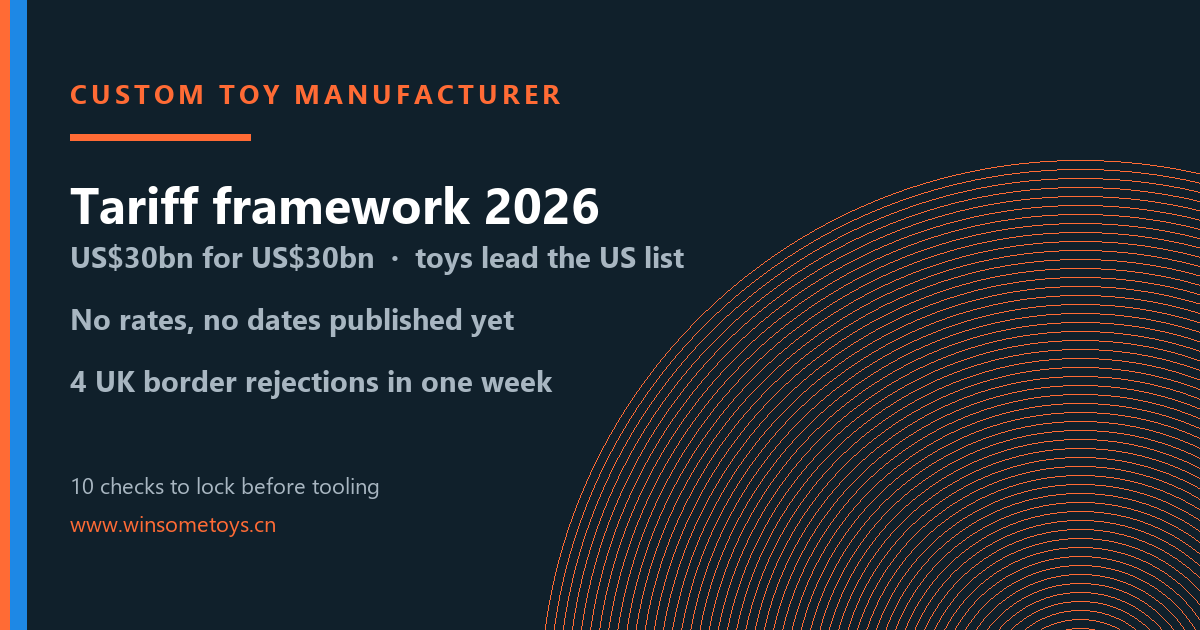
On 28 September 2026 China’s Ministry of Commerce published the outline of the “US$30 billion for US$30 billion” reciprocal tariff framework agreed during the eighth round of trade talks in New York and Washington. Each side will cut duties on roughly US$30 billion of the other’s goods, and more than 90% of the listed products will have all additional tariffs removed and revert to most-favoured-nation rates. Toys sit at the top of the American list, alongside home appliances, baby products, kitchen and bath goods and festive gifts.
If you run an own-brand programme with a custom toy manufacturer, that is the first genuinely positive duty news in two years. It is also not yet a number you can put in a costing sheet. This note separates what was agreed from what has actually taken effect, and then covers the part that decides whether a custom programme arrives at all: the design and documentation checks that four UK border rejections in one week show buyers are still getting wrong.
What was agreed — and what has not happened yet
The framework was settled at talks held from 20 to 23 September 2026, together with the working procedures of the new US–China Board of Trade. The Ministry of Commerce statement says the two sides agreed to provide reduced tariff treatment, on a reciprocal basis and in accordance with each side’s domestic laws and procedures, on imports of roughly US$30 billion each, benchmarked to 2024 bilateral trade volumes.
Two honest caveats belong next to that headline. First, no rates and no effective dates have been published. Both governments still have to complete their own legal processes and the reductions are to be implemented simultaneously afterwards. Second, the roughly US$60 billion combined figure represents existing trade that would move to lower rates — around 9% of 2024 bilateral goods trade — not new volume. Chinese commentary has added that the listed goods are to be handled separately and so should be relatively insulated from any future escalation, but that is commentary, not text of an implementing measure.
The practical instruction for a buyer is unglamorous: keep paying current rates, keep your entry records accessible, and wait for the implementing action before you re-price a programme.
Three cost items that are already certain
While the tariff line waits, three other numbers have moved.
- Merchandise processing fee. CBP’s FY2027 COBRA fee adjustment took effect on 1 October 2026. The ad valorem rate stays at 0.3464%, but the minimum rises to US$34.58 and the maximum to US$670.86 per entry. On small, frequent shipments the minimum is the one that bites.
- IEEPA refunds. CBP confirmed in a court filing that it has processed the large majority of IEEPA tariff refund claims, with approximately US$122 billion of refunds and interest already certified and sent to the Treasury for payment. Phase 3 of its CAPE refund programme opened on 6 October for eligible importers covered by the court’s reliquidation order. If you paid IEEPA duties, that is worth a look this month.
- Demand. US Halloween spending is projected to reach US$13.5 billion in 2026, with consumers starting to buy in September. Festive goods are on the US tariff list too, so the seasonal build and any eventual duty relief land in the same quarter.
What actually stops a custom programme at the border
On 8 October 2026 the UK Office for Product Safety and Standards published three toy product safety reports. All three were China-origin. All three were rejected at the border.
- Electronic Guitar Toy (2609-0125) — high risk of strangulation: the adjustable neck strap has no effective breakaway mechanism. The report also records sound levels above the permitted limit for hand-held toys, and a battery compartment securing screw that can be fully removed, giving access to the batteries. The import was rejected at the border and destroyed.
- Warrior Crossbow Toy (2609-0218) — serious choking risk: the suction cups fitted to the arrows can detach during use, and the detached cups are small enough to fit entirely within the small parts cylinder. Rejected at the border.
- Pop Bubble Fidget Toy Keyrings (2609-0228), sold via Amazon — high risk of asphyxiation: the flexible plastic packaging bag is larger than 100 mm by 100 mm and below the minimum required thickness. The pop-its and chains also fit wholly in the small parts cylinder, and the labelling and markings need improvement. Rejected at the border.
A few days earlier, Squishy Steam Bunz Dim Sum Toys were rejected at the border after testing identified volatile organic compounds including xylenes and styrene. That report is the instructive one, because it also records no evidence of UK conformity assessment, no technical documentation and no production control, alongside missing labelling and marking — and flags the product as counterfeit.
None of the four was stopped by an exotic laboratory finding. A strap that should break away, a screw that should stay captive, a suction cup that should stay on, a bag that should be thicker, a file that should exist. Those are all decided on the drawing board and in the artwork — which is precisely the stage a custom programme controls and a catalogue order does not.
Ten things to lock before tooling
- Name the standard and its version in the specification — EN 71, ASTM F963, CPSIA, the Toys (Safety) Regulations 2011 — rather than “EU/US compliant”. The version decides which clauses the test report is read against.
- Design-review the recurring failures: cords and straps need a breakaway; battery compartment screws must stay captive; anything that can detach has to be checked against the small parts cylinder; hand-held sound toys have limits; flexible film packaging has a minimum thickness and a size threshold.
- Decide who the manufacturer is. Under the EU General Product Safety Regulation, a business that has a product designed or manufactured and markets it under its own name or trademark is deemed the manufacturer and takes on the manufacturer’s obligations — technical documentation, product marking, and keeping that documentation available.
- Assign the technical file by name and say where it lives. A file nobody can retrieve in 48 hours is not a compliance system; it is a folder.
- Lock the bill of materials and the golden sample, and write change control into the contract: resin, coating, battery, electronics or subcontractor changes need prior written approval and a retest trigger.
- Require test reports that match the exact model, material and production site. Declarations for a component do not replace a declaration for the finished product.
- Build in traceability: a type, batch or serial identifier on the product or packaging, carried through to carton level. Border reports cite carton and SKU identifiers because that is how a shipment gets identified.
- Sign off artwork before the packaging run — importer details, age grading, warnings and the language of the destination market.
- Quote with duty as a separate line, so the framework above can be applied to one cell instead of renegotiated across the whole sheet.
- Agree the alert procedure in writing: who notifies whom, in how many hours, and who pays.
Where to go from here
Tariff relief, if and when it is implemented, is worth real money on a programme of any size. It is also the item you control least. The items you do control are the ones that turned four shipments around at the UK border this month.
Our OEM and ODM toy manufacturing page covers how development, tooling and production are run, and the toy quality control and safety compliance page covers what we check and document before a shipment leaves. How we work with importers and distributors is on the about page, and our base in the cluster is described on the Chenghai, Shantou toy factory page. If you are developing an item with electronics or sound, the remote control toys category is the closest match to the failure modes listed above.
Send us the drawings, the target market and the age grading and we will tell you which checks on the list apply to your item, and what needs to be settled before a tool is cut. Start an enquiry here.