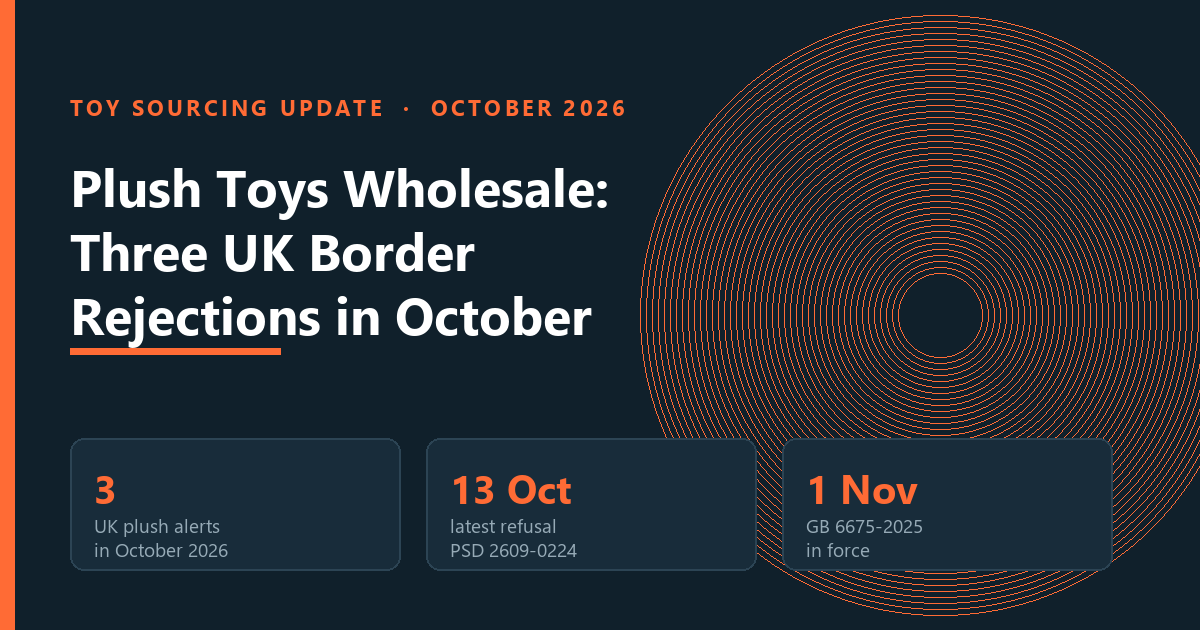
On 6 October 2026 the UK Office for Product Safety and Standards published two product safety reports on plush toys made in China. On 13 October it published a third. All three name the same corrective action: import rejected at the border. Not one of them involves an exotic chemical finding or a novel hazard. Every one of them is about things nobody checked before the goods were packed.
That is the uncomfortable part for anyone buying plush toys wholesale. The demand side is healthy: Circana’s first-half 2026 figures, reported by The Toy Association on 10 August 2026, put global toy dollar sales up 14% year on year, with the United States up 17% in dollars and 12% in units. What stops a plush container is not a market failure. It is a seam hole, a loose loop and a plastic bag that is a fraction too thin.
What failed, in order
The three alerts name the same brand, InteDesign, and the same country of origin, China, and all of them cite the Toys (Safety) Regulations 2011.
- 2609-0223, 6 October 2026, high risk. InteDesign Plush Toys, model TT25274-A1, carton identifiers X002AMDX99 and FBA15M5PLJPVU000005 (cartons 1-5), mixed SKUs P1-B5. A single finding: the flexible plastic packaging bag has an area greater than 100 mm x 100 mm and its measured thickness is below the minimum specified, so a child can place it over the mouth and suffocate.
- 2609-0227, 6 October 2026, serious risk. The InteDesign Knitted Tea Mug Plush Toy, sold via Amazon, refused entry at the border.
- 2609-0224, 13 October 2026, high risk. InteDesign Plush Caterpillar Toys, model TT25274-A2, carton identifiers X002AMBT63 and FBA15M5PLJPVU000009 (cartons 6-13), SKUs P1-B9. Three findings: the same packaging film problem; a hole in the seam at the back of the head of the yellow toy that gives access to the internal fibrous filling, which a child can pull out and choke on; and an attachment loop on the pink toy that detached during testing, leaving an accessible cord able to wrap around a child’s neck.
Two details turn this from three isolated entries into a pattern. The model numbers are sequential — TT25274-A1 and TT25274-A2 — and the carton identifiers share the same Amazon inbound prefix, FBA15M5PLJPVU, with cartons 1-5 in one alert and cartons 6-13 in the next. Consecutive shipments of the same model family were refused entry a week apart, for largely the same reasons. Whatever was fixed after the first refusal did not reach the second batch.
Why “rejected at the border” costs more than a recall
OPSS uses several different measures and they are not equivalent. A recall from end users carries a consumer remedy — refund, repair or replacement — and a public route back to the brand. An import rejection carries neither. The goods have been paid for, they have been shipped, and they cannot be entered. The importer is then negotiating storage, re-export or destruction while the Q4 selling window closes.
“Removal of the listing by the online marketplace” is a third failure mode, and for an Amazon-first seller it can be worse, because the stock may already be sitting in a fulfilment centre. A toddler ghost costume, PSD 2609-0106, published on 13 October 2026, is a clean example: a cord longer than the permitted length for toys intended for young children, packaging film below the minimum thickness, and required documentation and markings not present. Amazon removed the listing. Same regulation, different channel, same lesson — soft goods fail on construction and documentation long before they fail on chemistry.
Four checks that would have caught all of it
- Seam integrity, tested on production samples rather than the golden sample. A hole anywhere on the body is an access route to the filling. On the caterpillar, the failure was at the back of the head — a place a sample photograph will never show.
- Every loop, ribbon and attachment point gets a pull test. The pink toy’s loop detached during testing, which converts a decorative feature into a cord. Any loop that can come free under load becomes a strangulation hazard, and the age grading will not save you.
- Packaging film is part of the product. It is the single most repeated finding across UK toy alerts this autumn. Specify the film thickness in microns, the bag opening dimensions and whether the bag is perforated, and put all three on the specification sheet.
- Documentation and markings travel with the shipment. The costume alert explicitly notes missing documentation and markings. Traceability, importer or responsible-operator details for the destination market, age warnings and language requirements are cheap to get right before loading and expensive to argue about afterwards.
A second date to plan around: 1 November 2026
GB 6675.1-2025 was published on 5 October 2025 and takes effect on 1 November 2026, replacing the 2014 edition. The chemical requirements expand most: the phthalate list grows from six to ten substances, and new limits are introduced for formaldehyde, benzene, toluene, xylene, total volatile organic compound (TVOC) emissions and migratable boron. TVOC emission is entirely new to the series.
Plush is precisely the construction that feels that change, because fabric, foam filling, coatings and adhesives are all emission sources. Ask the lab to quote against the new standard now rather than after 1 November, and write the standard number into the product specification so it becomes a contract term instead of a question. Where a supplier also ships into China, expect the material set to be re-qualified in the coming months — re-qualification is exactly when substitutions creep in, so it is worth re-testing your export SKUs rather than assuming continuity.
Demand is not the problem
Circana’s first-half 2026 read is unambiguous. Global toy dollar sales rose 14%, the strongest first half in six years for the US market, where average selling price rose 4% alongside 12% unit growth. Purchases by adults aged 18 and over grew 25%, purchases by 12- to 17-year-olds grew 33%, and adult-only households accounted for 55% of US toy sales through June.
That mix is good for plush. A higher average selling price plus an older buyer is where soft toy quality converts directly into margin — better fabric, denser embroidery, more accurate licensed characters. It is also bad news for the cheapest end of the category, because a border rejection turns a low unit cost into a write-off plus freight and handling on both legs.
What to write into the purchase order
- A pre-shipment test report to EN 71-1, EN 71-2 and EN 71-3 — or ASTM F963 for the US — from an accredited laboratory, quoting the batch or shipment reference.
- Seam and attachment pull-test results from production samples, with photographs.
- A packaging film specification in writing: thickness in microns, bag opening dimensions, perforation.
- A markings and documentation pack for the destination market: traceability, importer or responsible-operator details, age warning and required language.
- A clause stating who bears the cost if the shipment is refused entry.
- A bill-of-materials hold: the supplier notifies you before changing fabric, filling, coating or adhesive, because a substitution can reset the test report you hold.
Next step
None of this is an argument against buying plush from China. It is an argument for buying plush toys wholesale from a supplier that treats seams, loops and packaging film as specification items rather than finishing details. The three October alerts are not hard cases — they are ordinary work that did not get done, twice, on consecutive shipments.
Start with the construction file rather than the sample. See how we structure quality control and safety compliance, browse the current plush toys range, and review how we run OEM and ODM programmes. If you are planning a Q4 or spring plush programme, read about our factory in Chenghai, Shantou and about Winsome Toys, then contact our team with your specification and the market you ship into.