China replaces its entire mandatory toy safety series on 1 November 2026. GB 6675.1 to GB 6675.4-2025 were published on 5 October 2025 and will supersede the 2014 versions that most factories still quote on their test reports. For anyone running an OEM toy manufacturer relationship, the date matters less as a laboratory problem than as a paperwork problem: it reaches your purchase order, your material approvals, your tooling schedule and your certificate file.
Two events this month turned a calendar entry into an operational one. On 12 October 2026 the Beijing Consumers’ Association published a comparative test of 38 stress-relief toys, with a pilot check against the new standard’s flagship chemical metric; results were poor for exactly the squishy and slime lines that dominate private-label programmes. Ten days later CPSC recalled about 6,533 Chinese-made light-up finger toys for accessible button cells. Same month, two rulebooks, two failure maps.
What actually changes on 1 November
The chemical upgrade is the headline: ten classes of harmful substances gain limits, covering swallowing, mouthing and skin contact rather than coating migration alone.
- Formaldehyde: at or below 30 mg/kg for key materials on toys for children under 36 months.
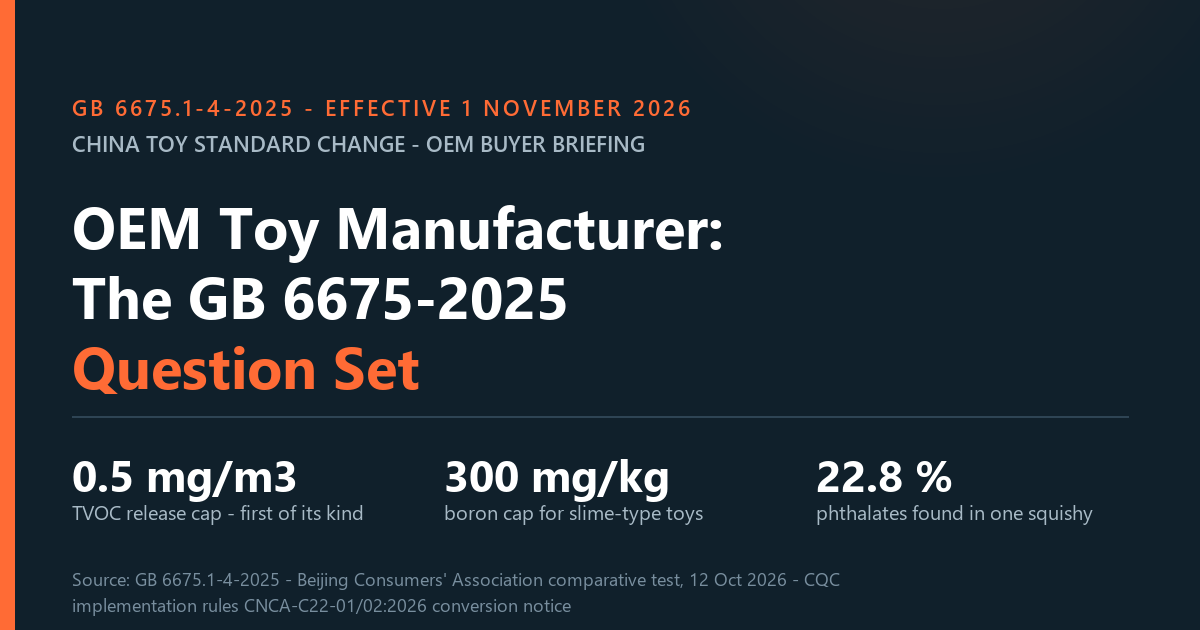
- TVOC release: at or below 0.5 mg/m³ – according to the Ministry of Industry and Information Technology, the first time any toy standard in the world has set a limit for total volatile organic compound emissions.
- Phthalates: the number of controlled plasticisers rises from six to ten.
- Boron: at or below 300 mg/kg for crystal slime and similar putty-type toys.
- Short-chain chlorinated paraffins join the list, along with benzene, toluene and xylene.
The quieter changes are mechanical and fire-related, and they hit specific product types. New requirements arrive for toys with open-flame devices and for food-shaped toys; those for yo-yos, inflatable toys and suction-cup projectiles are revised. On fire safety, masks and other head-worn toys gain a flame-resistance requirement, and the test methods for disguise costumes, toy tents children can enter and soft-filled toys are rewritten. If your line sits in any of those families, ask for the clause-by-clause gap before you ask for a price.
Why the squishy line is the early warning
The Beijing Consumers’ Association bought its 38 samples from e-commerce platforms, supermarkets and stationery shops, split across crystal slime, squishy (kneading) and press-type categories, and tested them against the current standard, GB 6675.1~4-2014. It then added a pilot TVOC check against the incoming version:
- All 38 passed the migratable lead test – that is no longer the weak point.
- Small parts: one liquid-glass slime shed parts in normal use; under foreseeable abuse pulling, biting and dropping, four products shed parts or split open.
- Phthalates: 37 complied. One squishy product came in at 22.8% total DBP plus BBP plus DEHP, against a combined ceiling of 0.1% for those three under the current standard – roughly two hundred times over.
- TVOC pilot: crystal slime and squishy categories performed weakest overall, with most samples releasing high levels under sealed conditions and an obvious sharp smell on opening. Press-type products fared noticeably better.
The association pushed retail channels to delist the affected lines and called on manufacturers to use the remaining transition time to re-formulate: low-volatility TPR or PU for squishies with longer devolatilisation and curing, a revised glycerin-to-silica ratio for slime, and boron control ahead of the new limit. Those are material and process decisions, not inspection outcomes.
The certificate side nobody puts in the contract
GB 6675 is not only what gets tested – it is also the basis of China Compulsory Certification for toys and ride-on products. The certification implementation rules have been revised alongside the standards: CNCA-C22-01:2026 for ride-ons and CNCA-C22-02:2026 for toys, both effective 1 November 2026. The China Quality Certification Centre has set out how the conversion runs:
- Until 31 October 2026 manufacturers may certify to either version; from 1 November 2026 new certificates are issued to the new standards only.
- Existing certificates must be converted: all conversions are due by 1 November 2027 or the certificate is suspended; anything unconverted by 1 February 2028 is revoked.
- If the revision adds no new test item for a given product, that product need not be retested and the certificate can be exchanged directly. Where new items apply, differential testing must be carried out first.
- Products already manufactured and placed on the market before 1 November 2026 and no longer in production are exempt from conversion.
That last distinction is where programmes quietly stall. Tooling you own may sit on an old-standard certificate that needs differential testing before it can be exchanged – and testing slots get scarce in the month before an effective date. Get the target conversion date into the purchase order. See the toy quality control and safety compliance page for our own workflow.
Three windows for stock already moving
The Beijing Consumers’ Association framed the changeover as three periods – a useful planning frame for buyers too:
- Before 1 November 2026: goods marked to GB 6675.1~4-2014 can still be bought and sold normally.
- 1 November 2026 to 31 October 2027: newly produced toys must meet the new standard, while inventory made earlier to the old standard may still sell through.
- After 1 November 2027: everything in circulation has to meet GB 6675.1~4-2025.
Treat this as a scheduling aid, not legal advice: if you hold inventory across the boundary, confirm your position with your own counsel and the certification body.
Eight questions to put in writing to your OEM toy manufacturer
Most of what follows costs nothing to ask and is expensive to discover later:
- Which standard version does the purchase order cite? Write GB 6675.1~4-2025 in full. “GB 6675” alone defaults to whatever version the factory last tested against.
- Is there a current test report per material, per colour, against all ten new substance categories? Phthalate-only reports are the norm and will not cover TVOC, formaldehyde or boron.
- Who funds re-formulation? A TVOC failure is solved in the resin and the curing cycle – a real cost item, not a defect the factory absorbs automatically.
- Who pays for differential testing and certificate conversion? Put the plan and the date in writing.
- Can you show the CCC certificate number and its conversion status per item? It is the first thing a marketplace or an officer asks for.
- Does the artwork declare GB 6675.1~4-2025? A wrong standard number on the carton can make a compliant product unsellable.
- Has the hand-feel or colour changed after re-formulation? If so, your approval sample needs re-confirming.
- Which destination-market reports cover this shipment? EN 71 for the EU, ASTM F963 for the US. A Chinese standard update does nothing for either.
One rulebook is never enough
On 22 October 2026 CPSC recalled about 6,533 Bamamon LED Projecting Finger Light toys (recall number 27-042), sold on Amazon.com from March 2025 through August 2026 for roughly $13 to $14. The toys contain three button cells in compartments children can open. The same day the agency warned consumers to stop using squishy toys distributed by Kaizou Group over water-bead ingestion, and recalled 94 light-up princess costumes for accessible button cells.
None of these is a chemical story, and perfect TVOC compliance would not have prevented any of them. GB 6675-2025 raises China’s chemical bar; the recurring US failure mode stays mechanical. Budget testing per destination market, not one certificate for everywhere.
What to do before the end of the month
If you have open programmes with an OEM or ODM toy manufacturing partner, use the remaining days to lock three documents: a specification naming GB 6675.1~4-2025, a material re-approval covering the new chemical items, and a certificate conversion plan with dates. Tooling, artwork and bookings all wait for those three.
Winsome Toys builds OEM and ODM toy programmes out of Chenghai, Shantou, working to written specifications agreed before sampling rather than after inspection. Whether your next line is plush toys, educational toys or something else, the same rule applies: the standard version belongs in the contract, not the email thread. Read more about how we work, then send us the specification you are quoting and we will tell you what has to change before 1 November.