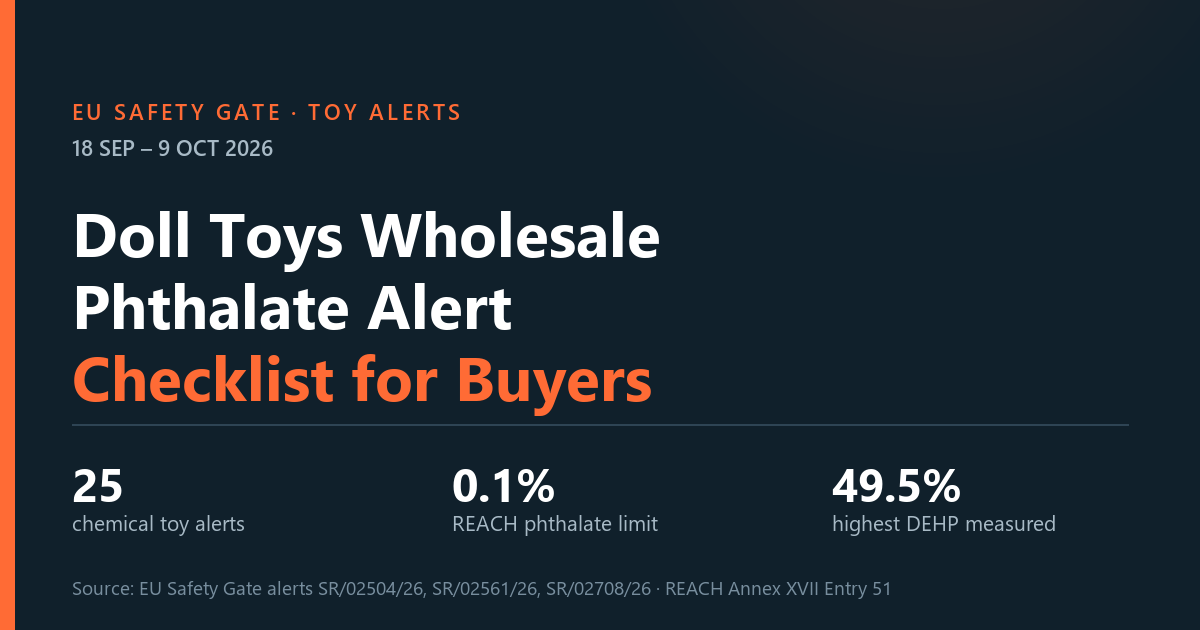
Between 18 September and 9 October 2026 the EU Safety Gate system published 25 serious chemical-risk alerts on toys. Ten of the twelve alerts in the September wave named phthalates in plastic dolls and plastic toy sets, and every one of those twelve products originated in China. For anyone buying doll toys wholesale, this is not a consumer story — it is a sourcing story. The measures listed in those alerts (withdrawal from the market, ban on marketing, destruction of the product, recall from end users) attach to the importer, distributor or brand owner whose name is on the technical file, not to the factory that moulded the part.
The numbers deserve a second read. DEHP was measured at up to 49.5% by weight in one September alert, against a legal limit of 0.1%. In a separate alert the doll body itself came back at 0.16% while its packaging came back at 17%. Phthalate failure in dolls is rarely a marginal tolerance problem. It is a formulation problem, and it is invisible on a golden sample that looks perfectly fine on a shelf.
What the two waves actually contain
The first wave ran from 18 to 25 September 2026: 12 serious chemical-risk alerts on toys, 10 of them citing DEHP, DBP or DIBP, all 12 of Chinese origin. Hungary notified four, Poland three, Finland two, with one each from Cyprus, France and the United Kingdom (in respect of Northern Ireland). The two non-phthalate alerts covered boron migration from toy slime and an accessible battery compartment.
The second wave ran from 2 to 9 October 2026: 13 serious alerts, 11 of them Chinese origin, notified by Germany (4), France (3) and Poland (2). Four covered plastic toys and dolls; four covered latex balloons releasing nitrosamines and nitrosatable substances at measured levels between 0.21 and 4.69 mg/kg. Eleven alerts cited the Toy Safety Directive 2009/48/EC, two cited REACH, and one cited the Cosmetic Products Regulation for benzene in face paint.
An ECHA Enforcement Forum project (REF-5) has previously found phthalate non-compliance in the range of 20% to 25% of toys checked. That figure is the reason to treat this cluster as a systemic defect pattern rather than three unlucky suppliers.
Three doll alerts you can check your own line against
- SR/02504/26 (published 18 September 2026, notified by Hungary): “Mermaid Girl” battery-operated plastic doll, brand Abababy, model +1913-18, barcode 6225010390284, packed in a plastic bag with a blue cardboard header. Measured DEHP up to 0.16% in the doll’s arm and 17% in the packaging. The authority ordered withdrawal from the market and a ban on marketing, in force from 24 June 2026.
- SR/02561/26 (published 25 September 2026, notified by Poland): plastic doll in a baby walker with imitation cutlery, brand “For fun”, model 1303-11, barcode 2281303433902, in plastic net packaging with a cardboard label. Measured DEHP up to 0.26% by weight. The importer’s measures — withdrawal, destruction of the product and warning consumers — took effect on 10 August 2026.
- SR/02708/26 (published 2 October 2026, notified by Poland): plastic doll with a textile dress, brand Gina (Gina Toys). Measured DEHP up to 0.2% by weight; found not to comply with REACH or with the Toy Safety Directive. The importer withdrew the product, warned consumers and destroyed stock, effective 14 September 2026.
Read the three together and a pattern appears. None is a headline brand. All three carry a model number and a barcode a buyer could have matched against a purchase order. All three were caught at import or retail level, after the goods had been paid for and shipped. And in all three the remedy was destruction, not rework.
Why dolls fail when other toys pass
A doll is not one material. It is a vinyl or PVC body, rooted hair, textile clothing, small accessories, and printed or plastic packaging. Under REACH each of those is a separate homogeneous material, so a compliant body can still be failed by a hair band, a handbag, a comb or a header card.
The Abababy alert is the clearest illustration: the packaging carried more than a hundred times the phthalate concentration found in the doll itself. Buyers who test only the toy and not the bag it ships in are testing the wrong half of the product.
The usual root cause is a cheap plasticiser package or regrind of uncertain origin. It does not show up in a pre-production sample that was made from a controlled batch; it appears when a different lot is blended to hit a price. That is why the test report matters more than the sample.
The limit, and what breaching it costs
REACH Annex XVII, Entry 51 sets the limit for DEHP, DBP, BBP and DIBP at 0.1% by weight in toys and childcare articles. The measures actually applied across these alerts were withdrawal from the market, ban on marketing, recall from end users, destruction of the product and public warnings to consumers.
For a wholesale buyer the direct costs are the written-off stock, the freight already paid, and the delisting. The indirect cost is that the importer’s name sits in a public EU alert database — which is exactly the first place a retail buyer’s compliance team looks when they review a new supplier.
China’s own standard changes on 1 November 2026
GB 6675.1–4-2025 was published on 5 October 2025 and enters into force on 1 November 2026, replacing the 2014 version. Among the chemical changes: the list of controlled phthalates goes from six to ten, adding DIBP, DPENP, DHEXP and DCHP at a limit of 0.1%; formaldehyde is capped for key materials in toys for children under 36 months; a toy-specific TVOC release limit is set for the first time internationally; and new limits appear for boron, short-chain chlorinated paraffins, PAHs, N-nitrosamines, formamide and allergenic fragrances.
The practical read is simple. A doll line backed only by a legacy six-phthalate report will not answer the question a European or Chinese inspector asks in November. Ask for the ten-substance report before the goods ship, not after.
Checklist before you confirm a doll order
- Ask for the ten, not the six. DIBP, DPENP, DHEXP and DCHP alongside DEHP, DBP and BBP, each against the 0.1% limit.
- Test by part, not by doll. Body, hair, clothing, accessories and printed packaging as separate line items.
- Tie the report to a batch. Supplier name, production date and PO or mould number. A report with no batch reference is a marketing document.
- Test the packaging. One of these three alerts failed on the bag, not the doll.
- Verify the file, not just the test. EC declaration of conformity, CE marking, traceability to the manufacturer, correct age grading.
- Confirm which standard version applies. GB 6675-2025 from 1 November 2026; EN 71-3 migration for painted or coated parts.
Timing matters for the Q4 season
Dolls are a gift-category purchase, and doll toys wholesale orders are placed months ahead of the season. A withdrawal notice that lands in late November does not arrive in time to reorder; it converts sellable stock into written-off stock. The two checkpoints that actually protect a Q4 doll programme are the pre-shipment phthalate report and the packaging test, and both have to happen before the container closes.
Our quality control and safety compliance process is built around exactly those checkpoints, and our OEM and ODM service covers material substitution when a line cannot pass on its current formulation. If you are planning a doll toys wholesale order or a plastic toy programme for the coming season, send the drawings and the target market and we will tell you which tests your programme needs. Related categories we produce include pretend play toys and baby and infant toys.
Talk to our team about your next doll programme — or read more about how we work on the about us page.