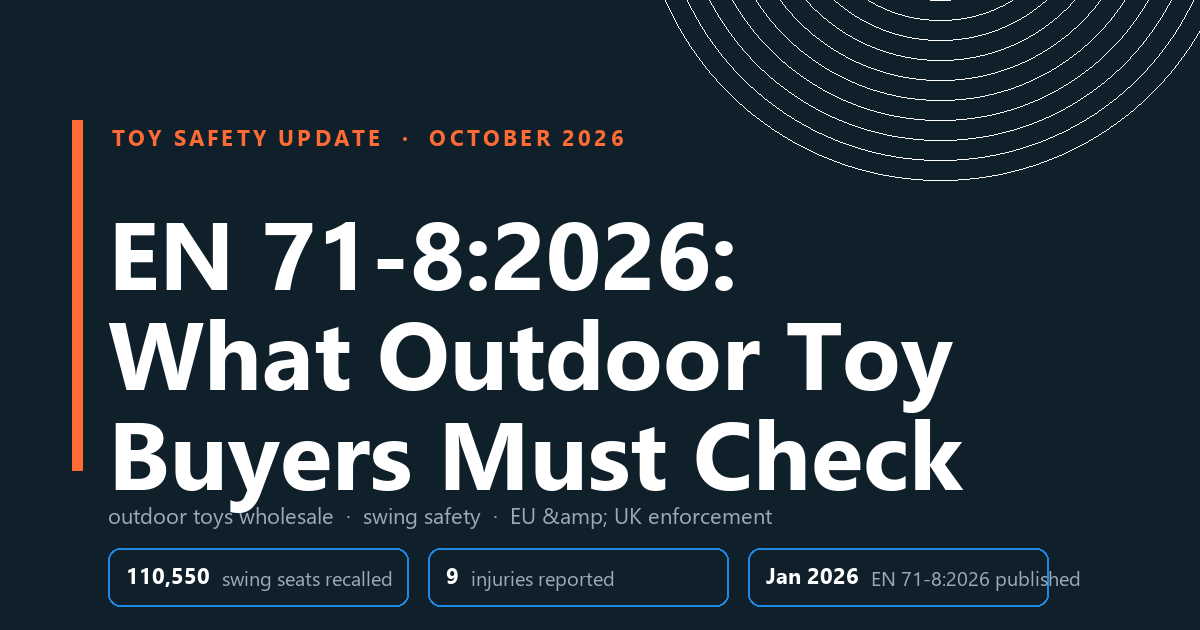
Two enforcement notices this month should change how importers and distributors approach outdoor toys wholesale. On 8 October 2026 the U.S. Consumer Product Safety Commission announced the recall of about 110,550 PACEARTH U-type swing seats. Pacearth Direct of City of Industry, California told the agency it had received at least 30 reports of falls, resulting in at least nine injuries including fractures and head injuries. The seats, metal carabiners or quick links, and webbing straps can break during use. The swings were sold on Amazon.com from May 2017 through June 2026 for between $27 and $57, and were manufactured in China.
On 12 October the UK Office for Product Safety and Standards published a different kind of outdoor failure. The Oakes Leisure Limited Warrior Crossbow Toy, PSD notification 2609-0218, barcode 6991200636677, batch 202601581A70 TCY063667, was rejected at the border because the suction cups fitted to the arrows detach during use and fit wholly inside the small parts cylinder. Two markets, two weeks, one shared lesson: active and load-bearing toys fail for reasons the standard indoor-toy checklist never catches.
Why outdoor toys are a different compliance regime
The distinction is written into the standards themselves. EN 71-8 covers activity toys for domestic use: products intended for children under 14 to play on or in, often attached to or incorporating a crossbeam, and often intended to bear the mass of one or more children. The defining test is not size — it is whether the product carries a child’s weight while that child moves.
Once it does, the risk model changes. EN 71-8 governs load-bearing strength and structural integrity, stability and resistance to overturning, fall space and impact-absorbing surfacing, and the dimensions of openings and gaps that could trap a head, torso or limb. It also carries detailed swing-specific provisions — seat size and strength, swinging space, and how suspension chains and ropes are connected — plus requirements for assembly instructions, anchoring and periodic maintenance guidance, because most domestic activity toys are self-assembled and their safety depends on being put up correctly.
The standard itself has moved: EN 71-8:2026
CEN published EN 71-8:2026 in January 2026. The SGS EU toy standards status sheet lists EN 71-8:2018 as the harmonised edition, cited in the Official Journal of the EU on 10 August 2018, and lists the 2026 edition as published but not yet harmonised. For a buyer that distinction is the whole point: until the new edition is cited in the OJEU, EN 71-8:2018 remains the reference for CE conformity. But it also means any supplier claiming “EN 71-8 compliance” should be able to tell you which edition the test report was issued against.
The most consequential change is scope. The 2018 edition explicitly excluded inflatable activity toys. The 2026 edition brings them in, with new definitions and a new test regime:
- New definitions separating contained-air inflatable activity toys from constant-air types, which require a blower running continuously.
- Blower placement: at least 2.5 metres from the toy.
- Structural requirements to prevent climbing on the containing walls.
- Anchorage requirements for larger structures.
- A test method for safe collapse following loss of pressure, so a child can evacuate.
Inflatables were previously routed to EC-type examination precisely because EN 71 did not cover all of their physical and mechanical hazards. Moving them into EN 71-8 changes both the test route and the documentation a buyer should expect to see.
The 2026 edition also revises the swing and access provisions: rope and suspension-diameter requirements with a revised measurement method, minimum clearance between adjacent swing devices and adjacent structures with the specific measurement points now named, a clarification on how to judge head and neck entrapment where a swing sits beside a slide, and finger-entrapment requirements split into separate forced-movement and falling scenarios. Ladder and access requirements were also revised, with exemptions for rungs and stiles meeting new grip and grasp dimensions.
What the PACEARTH recall actually tells you to test
The CPSC notice cites no chemical limit and no banned substance. It cites a fall hazard from structural failure — the seat, the carabiner or quick link, or the webbing strap breaking. The products were on sale for roughly nine years across a single marketplace listing. That combination is the warning: this does not look like one bad batch. It looks like a load path that degraded in service, and it only surfaced after enough units had been in use long enough.
For outdoor and active products, the test package should include:
- Static and dynamic load reports on the seat itself, not only on the frame.
- Rated load and batch certificates for every metal connector — carabiners, quick links, S-hooks — rather than a generic hardware datasheet.
- Tensile strength plus UV and abrasion ageing data for webbing straps and rope.
- Fatigue or cycle testing to a defined number of swings at rated load, with acceptance criteria stated in the report.
- Chain-coating integrity checks, since exposed links are a recognised finger-entrapment hazard.
US, EU and AU standards buyers routinely confuse
Ask a supplier for “EN 71 compliance” or “ASTM F963 compliance” on an outdoor product and you may get a technically true answer that proves nothing about the risk that actually applies.
- United States: ASTM F1148, the consumer safety performance specification for home playground equipment, is the relevant standard for swing sets and home playground structures. ASTM F963 is the toy standard and does not cover load-bearing playground equipment. The CPSC Public Playground Safety Handbook is the reference for public installations.
- European Union: EN 71-8 covers domestic activity toys — swings, slides, carousels, climbing frames, playhouses, paddling pools. EN 71-1, EN 71-2 and EN 71-3 still apply in parallel for mechanical and physical properties, flammability and migration of certain elements.
- Australia / New Zealand: AS/NZS 8124-6:2016 covers home swings, slides and similar activity toys, with added emphasis on material durability and UV resistance.
The practical check is simple. A report that names the family but not the part — “EN 71” rather than “EN 71-8”, “ASTM” rather than “ASTM F1148” — is not evidence for an outdoor or active product, whatever the cover page claims.
Outdoor toys wholesale: a pre-order checklist
- Name the clause in the PO. Write EN 71-8 (with the edition) or ASTM F1148 into the purchase order and the inspection criteria, not into an email.
- Confirm the age and weight band, and test the top of it. A swing rated for older children carries different loads than a toddler seat with a restraint system.
- Test the accessory, not just the hero product. In the Warrior Crossbow notice the failure was in the dart tips, not the bow.
- Require batch traceability. Carton identifiers, batch numbers and barcodes are what let you isolate a problem instead of recalling everything.
- Ask for the installation and maintenance instructions up front. They are part of the compliance file, and missing or mistranslated warnings are a recurring cause of market surveillance failures.
- Get the technical file before the deposit, not before shipment. Test reports, declaration of conformity, BOM and label photos are far cheaper to review than to argue about later.
The bottom line
Outdoor and active toys are where a sourcing programme meets structural engineering. The two October notices came from different regulators, covered different products and different hazards, and arrived within four days of each other. What they share is that neither would have been caught by a chemical screen.
If you are reviewing an outdoor toys wholesale programme for the coming season, the sequence that works is: confirm which standard edition applies to your destination market, get clause-level test reports that name the load-bearing parts and the connectors, and lock traceability into the PO before production starts. Our quality control and safety compliance page explains how we structure inspection and documentation, and the OEM and ODM process page covers where testing fits in the development timeline. You can browse the outdoor toys category, or the educational toys and remote control toys ranges if your assortment spans them. To discuss testing requirements for a specific product, contact our team.