EU Digital Product Passport for Toys: What Importers Must Know Before 2030
If you place a toy on the European Union market, the rulebook has fundamentally changed. On 1 January 2026, Regulation (EU) 2025/2509 — the new Toy Safety Regulation (TSR) — entered into force. From 1 August 2030, every toy sold in the EU must carry a Digital Product Passport (DPP), a scannable digital record that proves the product is safe, traceable and compliant. The traditional paper Declaration of Conformity is gone.
For toy importers, private-label brands and Chinese manufacturers in Chenghai, Dongguan, Shenzhen and Yangzhou, this is the biggest traceability shift in two decades. Customs authorities in Hamburg, Rotterdam and Antwerp will not need to open boxes to verify what is inside the container. They will scan the QR code.
This guide explains what the toy DPP actually contains, who is legally responsible for it, what it costs to implement, and how to prepare your supply chain without missing the deadline.
What is the EU Digital Product Passport for Toys?
The Digital Product Passport is a machine-readable digital record linked to a unique product identifier. For toys, it is required under Article 7(2) and Article 22 of Regulation (EU) 2025/2509. It replaces the paper Declaration of Conformity that has been used since the original Toy Safety Directive 2009/48/EC.
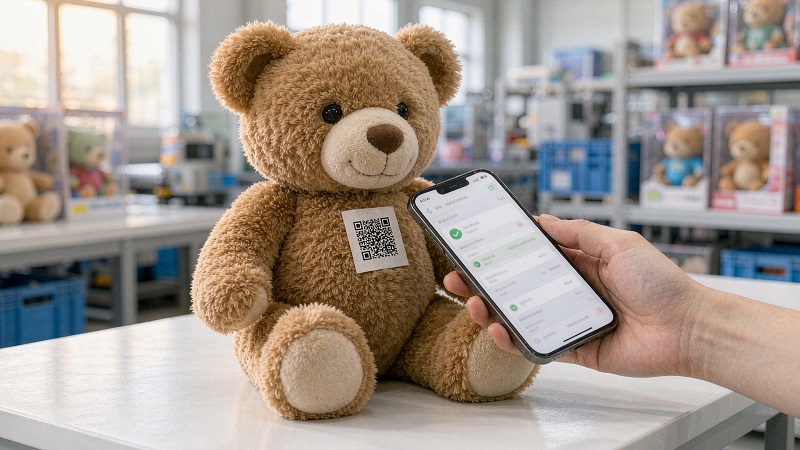
In practical terms, every toy model sold in the EU will need a data carrier — typically a QR code — printed on the product itself, on the packaging, or on an accompanying document. When scanned, the QR code opens a public-facing digital record hosted by the manufacturer or an authorised registry.
Mandatory contents of the toy DPP
Under the new regulation, the digital product passport for toys must include at least:
- Unique product identifier for the specific toy model
- Manufacturer or economic operator ID (name, postal address, email)
- References to all applicable EU legislation, including Toy Safety Regulation 2025/2509, REACH and the General Product Safety Regulation
- CE marking declaration
- Allergenic fragrance information where applicable
- Batch and serial identifiers for traceability
- Instructions for use and safety warnings (optional but strongly recommended)
Additional content — such as country of origin, raw material sources, recycled content percentage, repair instructions and recall status — can be added voluntarily to strengthen consumer trust and support ESG reporting.
When does the EU toy DPP become mandatory?
The TSR runs on a phased timeline:
| Date | Milestone |
| 12 December 2025 | Regulation (EU) 2025/2509 published in the Official Journal of the EU |
| 1 January 2026 | Regulation enters into force; certain chapters apply immediately |
| 1 August 2029 | European Commission to publish a dedicated SME guide for DPP creation |
| 1 August 2030 | Full mandatory application — DPP required for all toys placed on the EU market |
Until 2030, toys may continue to be placed on the EU market under the transitional provisions of Directive 2009/48/EC if they comply with the old rules. From the cutoff, products without a valid DPP are treated as non-compliant goods and are subject to customs seizure, market withdrawal and RAPEX notification.
The four-year transition window is generous on paper but tight in practice. For most Chinese toy exporters, the bottleneck is data infrastructure — not chemistry.
Who is legally responsible for the toy DPP?
Responsibility is layered across the supply chain, mirroring the existing CE marking framework but with stricter traceability.
Manufacturer (usually the factory)
The Chinese or EU-based manufacturer is responsible for:
- Creating and maintaining the DPP
- Affixing the QR code or data carrier to the toy or packaging
- Uploading the unique product identifier and economic operator ID to the EU DPP registry before the toy is placed on the market
- Retaining the underlying technical documentation for 10 years after placing on the market
- Setting up a consumer-facing communication channel to receive safety complaints (Article 7(12))
Importer
The EU-based importer must:
- Verify that the DPP has been issued and that the data carrier is present
- Confirm the manufacturer’s identification details
- Add their own name, postal address and email to the product or accompanying documents where the manufacturer is not established in the EU
Distributor and fulfilment service provider
A new actor introduced by the regulation is the fulfilment service provider, imported from the Market Surveillance Regulation (EU) 2019/1020. Anyone warehousing, packaging, addressing or dispatching toys on behalf of a non-EU seller is treated similarly to an importer and shares the same verification duties.
Online marketplace
Under the TSR and the Digital Services Act, online marketplaces must display the CE marking, safety warnings and a link to the DPP on every product listing. Non-compliant toys are treated as illegal content, not merely non-compliant goods.
What data does a toy DPP actually contain?
The regulation sets the mandatory floor. In practice, the most useful toy DPPs include the following structured fields:
Product identification
- Model number, GTIN/EAN, internal SKU
- Toy category (plush, electronic, wooden, outdoor, STEM and so on)
- Age grading and target age range
Compliance documentation
- Reference to Toy Safety Regulation 2025/2509
- Reference to REACH, POP Regulation, RoHS and any other applicable EU rules
- CE marking declaration
- Test report references (EN 71 series, EMC, REACH SVHC)
Material and chemical transparency
- Material composition (polymer types, fabric blends, wood species)
- Allergen declarations
- PFAS-free attestation where relevant
- Recycled content percentage
Supply chain traceability
- Country of final assembly
- Component and raw material sourcing regions
- Batch and lot identifiers
Lifecycle and consumer information
- Instructions for use and safety warnings
- Recall and safety alert status
- Repair, disassembly and end-of-life guidance
The DPP is meant to live beyond the point of sale. If a defect is discovered two years after manufacturing, customs and consumers can trace the exact batch and recall only the affected units.
How does the toy DPP affect Chinese manufacturers?
In 2024, China exported approximately USD 6.31 billion of toys to the EU. In 2025, that figure exceeded USD 8 billion, making the EU China’s second-largest toy export market after the United States. Every one of those shipments will eventually need a DPP.
The three practical pressures Chinese factories face are:
1. Data infrastructure gap
Most Chinese toy factories still operate on paper-based production records, Excel spreadsheets and informal messaging coordination. The DPP requires structured, queryable, registry-uploadable product data. Small and medium factories in Chenghai and Lianxia will need to invest in ERP upgrades, SKU-level batch tracking, and at least one qualified compliance officer who understands EU digital regulation.
2. Cost pass-through
Third-party implementation support is typically priced between EUR 1,500 and EUR 8,000 per SKU, depending on complexity, plus annual hosting and registry fees. For a factory running 200 active SKUs, that is a meaningful capital outlay before the first euro of incremental revenue. Buyers should expect modest price increases from EU-compliant factories during 2027–2029.
3. New gatekeeping role for online marketplaces
Amazon EU, bol.com and other major marketplaces will require a valid DPP link in the product feed before a toy listing can go live. Listings without a working QR code will be suspended. This shifts compliance from a one-time certification exercise to a continuous data-management discipline.
How should importers prepare between now and 2030?
Smart importers are not waiting until 2029. The most actionable steps right now are:
Step 1 — Inventory your SKUs and split them by compliance scope
Map every toy SKU you sell into the EU into three buckets:
- Continuing under 2009/48/EC until 2030
- Already aligned to TSR 2025/2509 because of chemical updates you made in 2026
- Requiring redesign for digital or AI toys that now fall under explicit TSR oversight
Step 2 — Pilot the DPP with your top 5 SKUs
Pick the five toys that drive the most EU revenue. Run them through a DPP platform — GS1, Circularise, Sinum or Kinechain are common choices in Europe. The pilot will surface gaps in your bill of materials data, test report indexing and batch numbering well before the deadline.
Step 3 — Update supplier contracts
Add three clauses to your factory purchase agreements:
- The supplier must maintain the DPP data on your behalf for 10 years
- The supplier must upload unique product identifiers to the EU DPP registry before each shipment
- The supplier must notify you within 48 hours of any safety incident, recall or material change
Step 4 — Align with the new GB 6675 China toy standard
China’s revised GB 6675 toy safety standards come into effect in late 2026 and are designed to align with the EU TSR. Testing done under GB 6675:2026 will cover most of the chemical and mechanical requirements of 2025/2509, reducing duplicate testing costs. Ask your lab whether existing certification can be cross-referenced to the TSR.
What happens if a toy arrives in the EU without a valid DPP?
Customs authorities have wide powers under the Market Surveillance Regulation. If a shipment arrives without a valid QR code or with a broken DPP link, the importer faces:
- Detention at port until compliance is verified
- Refusal of release and potential destruction of the goods at the importer’s expense
- RAPEX notification if the product is already on the market
- Fines ranging from EUR 5,000 to over EUR 1 million depending on the Member State
- Online marketplace delisting that can take 60–180 days to reverse
- Repeat offender status that triggers enhanced scrutiny on future shipments
For a buyer importing 40-foot containers of plush toys, a single failed DPP check on a single SKU can cascade into margin loss, demurrage charges and retailer chargebacks.
Frequently Asked Questions
What is the EU Digital Product Passport for toys?
It is a machine-readable digital record, accessed through a QR code on the product or packaging, that proves a toy’s compliance with Regulation (EU) 2025/2509. It replaces the paper Declaration of Conformity used under the old Toy Safety Directive 2009/48/EC.
When does the toy DPP become mandatory?
Full mandatory application begins on 1 August 2030. Toys placed on the EU market before that date may continue under the existing Toy Safety Directive, but new product launches from 2028 onward are strongly encouraged to adopt the DPP early.
Who creates and pays for the toy DPP?
The manufacturer is legally responsible. In practice, the cost is shared along the supply chain — the factory produces the data, the importer or brand owns the DPP platform subscription, and consumers access it free of charge.
Does every toy need its own DPP?
Yes. Each unique product model requires its own unique product identifier. Batch and serial identifiers live inside that record, allowing recall by batch rather than by SKU if needed.
Will Chinese toy factories be able to comply by 2030?
Large factories in Guangdong and Zhejiang are already piloting DPP systems. Mid-sized factories will need targeted investment in ERP, batch tracking and EU-specific compliance roles. The European Commission is due to publish an SME guide by August 2029.
Can I keep selling under Directive 2009/48/EC until 2030?
Yes. Transitional provisions allow continued placement on the market under the old directive until 1 August 2030, provided the toy was already on the market in conformity with the old rules.
Is the toy DPP the same as a CE mark?
No. The CE mark is a physical symbol indicating conformity. The DPP is the underlying digital record that backs the CE mark and contains the supporting evidence.
Conclusion
The EU Digital Product Passport for toys is not a passing compliance trend. It is the new operating standard for any brand selling toys in Europe. Chinese manufacturers, EU importers and private-label retailers that begin DPP pilots now — using their top-selling SKUs and their most demanding retailers as test cases — will enter 2030 with clean customs clearances, retailer trust and a defensible ESG narrative. Those who delay will face detention, delisting and margin compression in the same quarter.
The window between 2026 and 2030 looks long. It is not. The factories that succeed will be the ones that treat the DPP as a product feature, not a paperwork chore.
CTA — Sourcing Toys for the EU Market?
If you are sourcing, developing or private-labelling toys for the European Union, we can help you build the supply chain around the new Toy Safety Regulation. Our team works with factories across Chenghai, Dongguan, Shenzhen and Yangzhou to deliver OEM and ODM programmes that meet EN 71, REACH, CE, GB 6675:2026 and the upcoming Digital Product Passport requirements on schedule.
Contact our sourcing team to discuss your next EU-bound toy project — from material selection and lab testing to batch-level DPP registration and logistics support.
Suggested Internal Links
- [Toy Factory](/toy-factory) — Chenghai and Guangdong manufacturing capabilities
- [Toy Manufacturer](/toy-manufacturer) — OEM and ODM service overview
- [Quality Control](/quality-control) — Third-party inspection and lab testing
- [Contact Us](/contact-us) — Speak with our EU compliance team
- [About Us](/about-us) — Company background and export experience