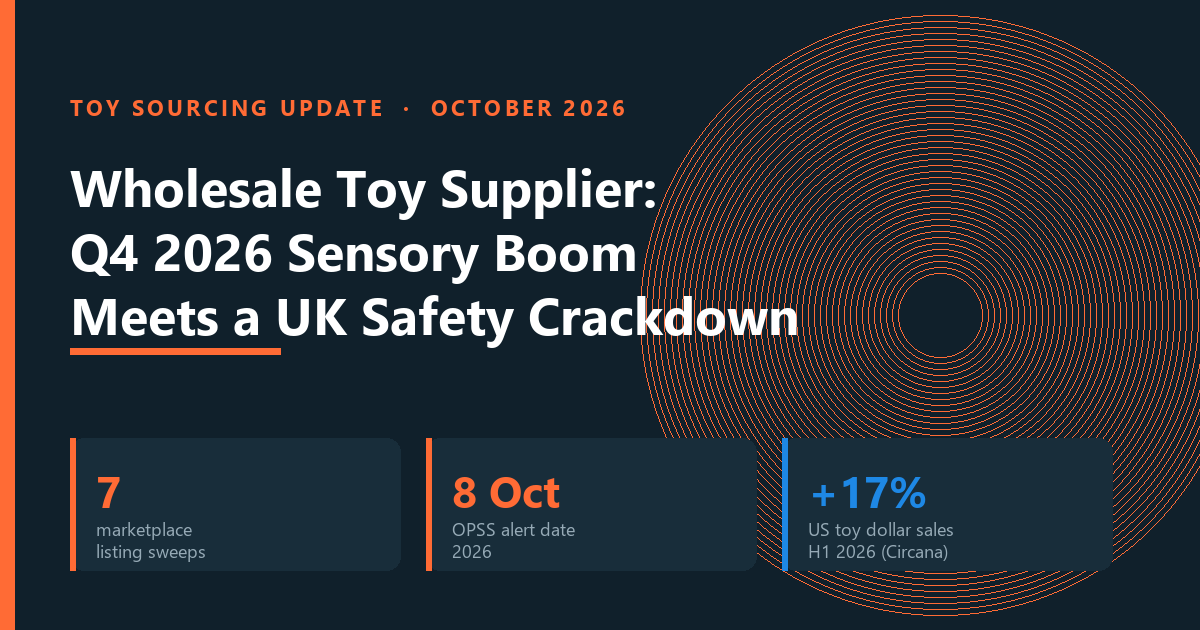
Sensory and squishy toys have been the fastest-moving toy category of 2026, and they go into the Christmas season as the impulse line every buyer wants next to the till. On 9 October 2026 the UK Office for Product Safety and Standards (OPSS) told consumers to stop using “pimple popping” squishy toys supplied with sharp needles or syringes, and published product safety reports covering seven online marketplaces. For anyone buying through a wholesale toy supplier, the timing is the whole point: the category with the strongest demand is now the category under the closest scrutiny, and the two things that decide whether a seasonal line makes money — sell-through and compliance — are moving together.
This is not a story about one bad factory. It is a reminder that a listing pulled by a marketplace costs you roughly what a recall costs you: the goods are unsaleable, the season is gone, and there is no orderly remedy process waiting for you. The difference is that you had no warning.
What OPSS actually did on 8–9 October 2026
OPSS says it opened an urgent investigation after reports that pimple popping squishy toys — soft toys sold with a needle or syringe so the user can inject air or liquid and then squeeze the resulting blister — were being sold in the UK. The regulator issued a public warning on 9 October and published a set of product safety reports, all dated 8 October 2026:
- Amazon — PSD 2610-0037
- eBay — PSD 2610-0032
- OnBuy — PSD 2610-0030
- Fruugo — PSD 2610-0031
- Wish — PSD 2610-0056
- Alibaba — PSD 2610-0052
- AliExpress — PSD 2610-0049
In each report the hazard is stated in the same words: “The toy was supplied with a needle or syringe with a sharp point that could puncture the skin and presents a risk of injury,” and the product “does not meet the requirements of the Toys Safety Regulations 2011.” The corrective action in all seven cases is removal of the listing by the online marketplace — not a consumer recall with a refund route. Country of origin is recorded as unknown. UK press reports (The Telegraph and Metro, cited by the Daily Mirror on 9 October) said at least one child required hospital treatment after piercing a finger with one of the needles; OPSS has asked anyone holding one to stop using it and to dispose of the needle in a puncture-resistant container.
Two details deserve a buyer’s attention. First, OPSS explicitly rejected the “adult stress toy” defence: “While many of the products are marketed as ‘adult stress toys’, they clearly fall within the scope of UK Toy Regulations and present a risk of injury to people of all ages including children.” Second, two of the seven platforms are cross-border wholesale channels. This story is not confined to consumer marketplaces.
Why the demand side makes the risk worse, not better
The reason so many buyers are reaching for this category is that the numbers are genuinely good. Circana’s US data for the first half of 2026 put toy dollar sales up 17% year on year — the strongest growth in six years — with units up 12% and average selling price up 4%. Sales to shoppers aged 18 and over rose 25%, and adult-only households accounted for 55% of total toy sales. Circana also reported triple-digit growth for squishy toys in both dollars and units from January through April 2026, describing sensory-driven toys as a standout category in which viral products are “increasingly shaping demand.”
On the retail side, Toys “R” Us is opening 120 standalone US stores for the 2026 holiday season, taking its domestic footprint from 40 to 160 locations. More shelf space in December means more buyers competing for the same sensory SKUs in October — and more pressure to accept a supplier you have not properly checked.
Packaging and accessories are where these lines fail
The needle is the headline, but the recent alert record shows the same pattern in quieter forms. On 6 October OPSS published a report on an InteDesign knitted tea mug plush toy sold via Amazon (PSD 2609-0227, China origin): the eyes could detach and fit entirely within the small parts cylinder, and the flexible plastic packaging bag exceeded 100 mm x 100 mm while falling below the minimum thickness — a child could put it over the mouth and nose and asphyxiate. The import was rejected at the border. Two days later, pop bubble fidget toy keyrings (PSD 2609-0228) drew the same packaging finding plus a small-parts choking risk, also rejected at the border.
Neither product failed because the factory could not make a soft toy. They failed on an attached component and on a bag. That is why a supplier questionnaire that only asks “do you have EN 71 / ASTM F963 test reports?” is not enough.
A due-diligence checklist before you place a Q4 order
- Ask for the target market and the standard in writing. UK: Toys (Safety) Regulations 2011 with EN 71. EU: Toy Safety Directive 2009/48/EC plus GPSR obligations. US: ASTM F963 and CPSIA, including tracking labels. If a supplier quotes a standard that does not match your destination, stop.
- Ask for the technical file, not a photo of a certificate. You want a test report with the laboratory name, report number, date, and a sample description that actually matches the item being shipped — including colourways and accessories.
- List every accessory separately. Needles, syringes, water beads, gel fillings, button cells, suction cups: each has its own clause. A compliant toy with a non-compliant accessory in the same bag is a non-compliant product.
- Treat packaging as part of the product. Flexible bags over 100 mm x 100 mm need minimum thickness and, in most markets, warning text and ventilation. Ask what film gauge is used and ask for it to be stated on the PO.
- Test the attachment strength of soft parts. Eyes, noses, bows and buttons on plush items are the classic small-parts failure. Ask for the seam-strength or tension-test results, and ask whether the test was done on production samples or on a golden sample.
- Confirm who is the responsible economic operator. Under the EU GPSR, putting your own brand on a product generally makes you the manufacturer, with the documentation duties that follow. In the UK you need a UK-based responsible person. Clarify this before the goods ship, not after a marketplace asks.
- Ask what happens if something goes wrong. A credible wholesale toy supplier can describe, in plain language, how a withdrawal would be handled: batch identification, contact route, and who pays for what. If the answer is silence, that is your answer.
What this means for your Q4 calendar
Christmas lead times are already tight. If you are still confirming a sensory or squishy line in mid-October, build two things into the schedule: a pre-shipment sample test against the destination standard, and a realistic fallback in case a listing or consignment is stopped. The cost of a two-week delay on a test report is small next to a container of goods that cannot be listed.
The wider lesson from 8–9 October is that enforcement now travels through marketplaces. A regulator can remove demand for your product in a day without ever inspecting your warehouse. The only defence available to a buyer is documentation that was collected before the order, not after the warning.
How we work with buyers on this
We are a Chenghai-based factory and sourcing partner, and we would rather talk through a specification than quote a price against an unclear one. Our quality control and safety compliance page explains how we approach testing and documentation, and the Chenghai factory page shows where the work happens. If you are building a Q4 sensory range, our plush toys and educational toys categories are the usual starting points, and our OEM and ODM services cover private-label programmes where you need your own branding on the documentation.
Send us the product, your destination market and your target ship date, and we will tell you plainly what testing that line needs. That is the least a wholesale toy supplier should offer. Start here: contact our team.