Global toy demand is not slowing down. According to Circana, in data released on 10 August 2026, toy sales across its 14 tracked markets grew +9.5% in the 12 months ending June 2026, and accelerated to +14% in value during the first half of 2026 versus the same period of 2025. For anyone buying wholesale toys out of China, that is the good news.
The harder news sits underneath it. Growth is real but sharply regional, the categories moving fastest are not the ones that led two years ago, and the duty stack on China-origin goods has been rebuilt more than once since February. This piece pulls demand and landed cost together into a plan you can use for Q4 2026 and the 2027 season.
Demand is strong, but it is regional
Circana’s regional breakdown for the 12 months ending June 2026 describes four quite different markets:
- North America – Games & Puzzles is the largest supercategory, driven by trading card games and collectibles. NFL ranked as the No. 1 licence, with FIFA the top-gaining licence.
- Latin America – Dolls lead by value, mini vehicles over-index against other regions, and trading card games are posting large gains off a small base. Growth here is outpacing Europe. Critically, December alone accounts for 32% of annual toy sales in the region, a higher concentration than anywhere else.
- Europe – Building Sets are the top supercategory. Annual spend per child under 10 reached roughly USD 240 in 2025, the second-highest globally. Star Wars was the No. 1 licence.
- China and Asia-Pacific – APAC is the fastest-growing region for toy sales. In China, Infant, Toddler & Preschool Toys remains the largest supercategory but ranked only fourth for growth, behind Arts & Crafts, Explorative & Other Toys, and Action Figures & Accessories. Circana links this partly to declining birth rates, with average selling prices rising as buyers trade up to higher-quality and educational products.
Australia is a useful read on the premium end. Circana reported on 19 August 2026 that the Australian market grew +13% in value in H1 2026, with units up 7% and average selling price up 6%. Eight of eleven tracked supercategories grew, and Games & Puzzles plus Building Sets together drove 70% of supercategory gains. Licensed toys grew 16% and reached 40% of category spend.
Three things this means for a wholesale program
- Sensory and collectible formats are carrying the momentum. Circana recorded the squishy segment growing by just over 400% in Australia in H1 2026, with slime adding renewed momentum to the compound category. Blind packs and collectibles also posted double-digit growth, largely off social media discovery.
- The premium tier is working. Australian growth was recorded across all price points but was strongest at USD 50 and above, where standard building sets and strategic trading card games together accounted for over half of sales. Shoppers will pay more for collectability and longer engagement.
- Seasonality now drives your production calendar. If you sell into Latin America, close to a third of annual volume lands in December. Tooling, testing and freight booking have to be locked well before summer, not in September.
The categories growing fastest are also the ones regulators are watching
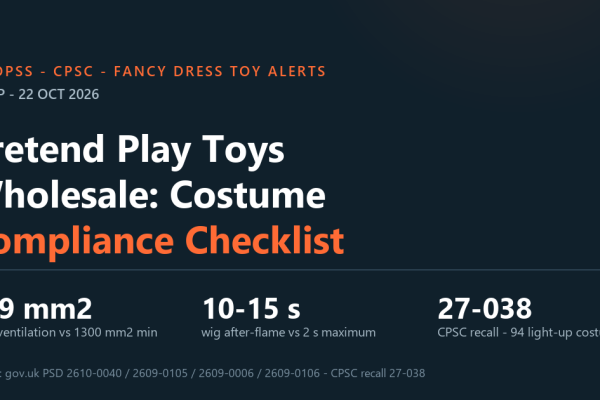
Squishy, light-up and small-format toys are exactly where enforcement has concentrated. In September 2026 the U.S. Consumer Product Safety Commission announced several recalls that wholesale buyers should read closely:
- 3 September 2026 – GIHNJSI Squeezy Dumplings toys, sold on Amazon.com during May and June 2026, about 8,000 units, recalled over water bead ingestion, choking and intestinal obstruction hazards. The seller was Xiamen Liuhui Electric Technology Co., Ltd. (dba Chenyuanhui), of China.
- 10 September 2026 – ZMC Group expanded its recall of battery-operated light-up children’s toys to about 245,124 units, because button cell batteries could be easily accessed by children. The products were manufactured in China and imported by ZMC Group Inc. of Los Angeles.
- Further recalls covered Skip Hop Baby Sesame Street Elmo silicone teethers and spiral toys distributed by SHEIN, both over choking hazards.
On the EU side, Safety Gate weekly notifications through 2026 remain dominated by toys, with choking and chemical risk the two leading causes and measures ranging from market withdrawal to refusal at the border. French authorities flagged a China-origin remote-control plastic toy (alert SR/02375/26, notified 28 August 2026) because the battery compartment could be opened without a tool, against the Toy Safety Directive and EN 62115.
The commercial point is simple: recall cost lands on the importer of record, not on the factory. Small parts, battery access and water bead containment need to be reviewed at the sample stage, and the test report has to match the materials and colours actually used in production. We describe our own approach on the toy quality control and safety compliance page.
What China-origin toys actually pay in duty right now
Tariff arithmetic has changed several times this year, so model it fresh instead of reusing last season’s numbers. As of mid-September 2026, most toys under HTS Chapter 95 carry a zero MFN base rate. The layered surcharges are the whole story:
- China-origin toys on Section 301 List 4A pay 7.5%.
- A Section 301 forced-labour tariff of 12.5% has applied to Chinese goods since 24 July 2026, the same day the 10% Section 122 tariff expired at its 150-day statutory limit.
- Combined, a typical List 4A toy lands near 20% in additional duty. A smaller group of toys on Section 301 List 3 sits closer to 37.5%. Confirm your own subheading – a ride-on, a puzzle and a plush animal do not all sit on the same list.
- Vietnam now sits at 12.5%, down from the 46% IEEPA rate that applied before the U.S. Supreme Court struck down the IEEPA tariffs on 20 February 2026 in Learning Resources v. Trump. Importers who paid IEEPA duties may be able to recover that layer through CBP’s CAPE process; Section 301 and Section 232 duties were not struck down and are not refundable.
There is also a live policy watch item. Chinese trade media have reported that USTR is preparing a reciprocal tariff-reduction package of around USD 30 billion that would include toys, with a landing window between late September and mid-November 2026. This has not been confirmed in a USTR notice at the time of writing – treat it as a watch item, not as a number to build a quotation on.
A landed-cost checklist before you commit to tooling
- Classify the SKU first. Confirm the exact HTS subheading before pricing anything. The gap between tariff lists is usually worth more than a round of unit-price negotiation.
- Request the current test report. Same tooling, same materials, every colour, dated within a year, from a CPSC-accepted laboratory for the U.S. or an EU-notified body for Europe. Check that the address on the report matches the factory address.
- Sign a golden sample. Approved by both sides with colour chips attached, before production starts.
- Quote packaging separately. Moving from a window box to a polybag changes freight, shelf appeal and unit cost. It should appear as its own line, not as a rounding difference.
- Book a pre-shipment inspection. Put defect definitions and the AQL on the purchase order, and pull the lab sample from the production lot rather than from the sample room.
- Model the full landed cost. Tooling amortised, duty at the current stack, freight, testing and packaging – then re-run it under an alternative sourcing country before deciding.
Where to start
Demand is healthy enough to justify building a program this year, but the money is made in the classification, the test file and the production calendar rather than in the unit price. Start with the category you want to build – educational toys, plush toys or baby toys – and work backwards from the shelf date.
For custom development and private-label work, see our OEM and ODM toy manufacturing services. If you already have a specification, send it through the contact page with your target market, quantity and required certification, and we will come back with a sourcing and compliance view before any quotation.