AI Toys Manufacturing in China: A 2026 Sourcing Guide for Toy Importers
Introduction
The global toy industry is undergoing its most significant transformation in decades. Artificial intelligence has moved from novelty to mainstream, and China’s manufacturing heartlands are at the center of this shift. In the first half of 2026 alone, China’s online AI toy sales reached 690 million RMB – a 202% year-on-year increase – while unit sales surged by 467%. For toy importers, wholesalers, and purchasing managers, understanding how AI toys are manufactured in China is no longer optional. It is becoming essential to staying competitive.
This guide breaks down the current state of AI toy manufacturing in China: where the key hubs are, what the market data tells us, what compliance hurdles exist, and how to source these products effectively.
The AI Toy Market in 2026: By the Numbers
Global Market Size and Growth
The global smart toy market was valued at approximately $21.4 billion in 2025 and is projected to reach $24 billion in 2026, growing at a compound annual rate of 12-22% depending on the source. More aggressive estimates place the market at $42.6 billion by 2031, while others project the global AI toy market could reach $36.4 billion by 2030.
China plays a dominant role. According to the Ministry of Industry and Information Technology, China’s AI toy market reached 29 billion RMB in 2025 and is expected to grow to 34.2 billion RMB in 2026. China accounts for over 36% of the global AI toy market – and that share is still climbing.
| Metric | 2025 | 2026 (Projected) | Source |
| Global smart toy market | $21.4B | $24.0B | Industry reports |
| China AI toy market | 29B RMB | 34.2B RMB | MIIT |
| Global AI plush toy sales | $1.1B | $1.47B | Market research |
| China online AI toy sales | – | 690M RMB (Jan-May) | Mojing Insights |
Why the Surge Is Happening Now
Several converging factors are driving the explosion:
- Large language models have become cheap enough to embed. Domestic Chinese models like DeepSeek and others can be deployed locally at costs far below Western cloud APIs, making generative dialogue and personalized interaction accessible even for small and mid-sized toy manufacturers.
- China’s supply chain density is unmatched. The Pearl River Delta – particularly Shenzhen and Dongguan – combines toy manufacturing expertise with electronics, chips, and module supply chains. Once AI voice modules are standardized, they can be rapidly integrated into existing toy product lines.
- Consumer demand has shifted toward interactive and educational play. Parents increasingly view toys as investments in their children’s development. STEM/STEAM toys are in high demand, and AI-powered companions that can converse, tell stories, and adapt to a child’s preferences meet this need directly.
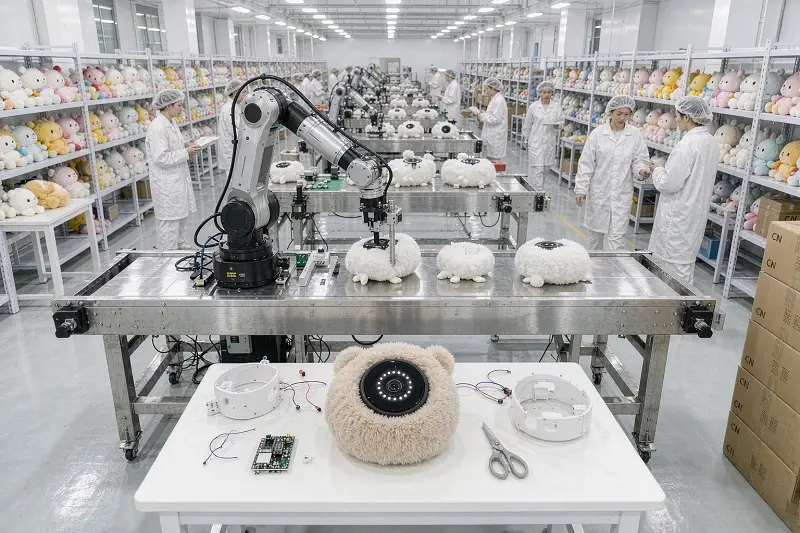
AI plush toys being assembled and quality-inspected on a Chinese factory production line
Where AI Toys Are Being Made in China
Dongguan – The Emerging AI Toy Capital
Dongguan, long known as one of China’s most important toy export bases, has positioned itself as the epicenter of AI toy manufacturing. According to Huangpu Customs data, Dongguan exported 10.77 billion RMB worth of toys in the first half of 2026, a year-on-year increase of 8%, reaching over 120 countries and regions.
But the more telling story is in the industrial transformation. The town of Chashan – a national hub for premium plush toys – has built a 140,000-square-meter AI toy industrial park. More than 20 companies there have already launched over 50 AI toy models. Chashan has also partnered with a national AI application pilot base to establish an AI Toy Empowerment Center, providing full-chain services from R&D to sales.
In nearby Shipai town, an AI design center has cut product development cycles dramatically: prototyping that once took three months can now be completed in 48 hours, with full production readiness in 72 hours – a 20% efficiency improvement.
One Chashan-based company, Jun’ou, produced over 200,000 AI plush toys in the first half of 2026 alone, generating 50 million RMB in revenue – matching its entire 2025 output in just six months. Their product line evolved from basic conversational toys (version 1.0) to emotion-aware companions (version 2.0) to fully interactive, touch-responsive, portable AI toys (version 3.0).
Shenzhen – The Technology Backbone
Shenzhen provides the electronics and chip supply chain that makes AI toys possible at scale. The city’s Huaqiangbei component market, combined with mature mold-making capabilities in the broader Pearl River Delta, means that toy manufacturers can source microphones, speakers, sensors, and AI modules within a 15-minute supply radius. This density is something no other country can replicate at the same speed.
Shantou (Chenghai) – Traditional Toy Hub Adapting
Chenghai in Shantou – historically known for plastic and remote-control toys – is also beginning to integrate AI capabilities. As a traditional manufacturing base with deep export experience, Chenghai’s factories offer the production capacity and quality control systems necessary for high-volume AI toy orders, even if the AI module integration is often sourced from Shenzhen-based technology partners.
What This Means for Toy Importers and Buyers
New Product Categories to Watch
AI toys are not a single product category – they span several:
- AI plush toys: Soft toys with embedded voice modules that can converse, tell stories, and respond to touch. The global AI smart plush toy market is projected to reach $1.47 billion in 2026.
- AI educational robots: Coding robots, science kits, and interactive learning companions. STEM robotics kits showed peak Amazon search volume of 3,583 in December 2025, with sales surging in January 2026.
- AI companion toys: Products targeting emotional support and companionship, increasingly popular not just with children but also with young adults and elderly users.
- AI-enabled traditional toys: Existing toy formats (dolls, figures, building sets) upgraded with modular AI voice boxes. LEGO’s Smart Play system, announced at CES 2026, represents the premium end of this trend.
Price Points Are Shifting
In early 2025, the AI toy market was dominated by relatively high-priced robots and robot dogs. As technology matured and costs came under control, entry-level educational and plush toy products flooded in. By May 2026, products priced under 500 RMB accounted for 74% of the market. This price restructuring means importers can now access AI toys across a wide range of retail price points – from mass-market to premium.
Sourcing AI Toys from China: Practical Advice
1. Understand the Technology Stack
Before placing an order, buyers should understand what they are actually sourcing. An AI toy typically consists of:
- Hardware: Microphone array, speaker, processor chip, sensors (touch, motion, proximity), battery, and Wi-Fi/Bluetooth module.
- Software: A large language model (cloud-based or edge-deployed), speech recognition, text-to-speech, emotion recognition, and conversation management.
- Content: Educational content, stories, games, and language packs – often localized for different markets.
The quality of the AI model and content ecosystem often matters more than the physical toy itself. A well-made plush toy with a poor AI experience will generate returns. Industry data shows AI toy return rates as high as 40%, with users losing interest within a week when the interaction feels shallow.
2. Choose the Right Manufacturing Partner
Not all factories claiming to make AI toys are equal. The market has seen a flood of “model-wrapping” products – essentially a standard toy with a generic AI model bolted on, producible for around 200 RMB in half an hour at component markets. These products rarely retain users.
When evaluating a supplier, look for:
- In-house or partnered AI development: Does the factory work with a dedicated technology team, or are they simply assembling off-the-shelf modules?
- Long-term memory capabilities: The real differentiator in AI toys is not whether the toy can talk, but whether it can remember and recall context appropriately. This requires sophisticated engineering.
- Content localization: Can the AI model support your target market’s language and cultural context? Many Chinese AI toys are optimized for Mandarin; ensure the supplier can deliver English, Arabic, Spanish, or other language packs.
- Compliance track record: Does the factory have experience with target market safety standards (ASTM F963, EN71, CPSIA) and data privacy regulations (COPPA in the US, GDPR-K in the EU)?
3. Navigate Compliance Carefully
AI toys introduce compliance dimensions that traditional toys do not:
- Toy safety standards remain non-negotiable. The physical toy must still meet ASTM F963 (US), EN71 (EU), CPSIA lead and phthalate limits, and other regional standards. Recent UK border rejections in August 2026 – including a plush cat toy destroyed for choking hazards and a play pen rejected for detachable small parts – underscore that physical safety compliance cannot be overlooked even when the selling point is AI.
- Data privacy regulations are critical. AI toys that collect voice data, process personal information, or connect to the internet are subject to COPPA (US), GDPR (EU), and similar regulations in other markets. In August 2026, China’s own toy recall system was actively enforced, with multiple Chenghai-based factories recalling products for safety defects – demonstrating that compliance enforcement is tightening globally.
- AI-specific standards are emerging. China’s first trade-related technical evaluation base for toy products was established in Dongguan in 2026, specifically to help manufacturers navigate foreign technical trade barriers. Importers should work with suppliers who are aware of and prepared for these evolving requirements.
4. Plan for Product Lifecycle and Support
AI toys are not set-and-forget products. They require:
- Ongoing content updates: The AI model and content library need regular updates to keep the experience fresh.
- Cloud infrastructure costs: If the toy relies on cloud-based AI, there are ongoing API or server costs that affect margin.
- Customer support: AI toys generate more customer inquiries than traditional toys – setup issues, connectivity problems, content requests. Factor this into your distribution strategy.
- Firmware updates: Security patches and feature updates may be needed throughout the product’s lifecycle.
Challenges and Risks to Watch
The AI toy opportunity is real, but buyers should enter with eyes open:
- High return rates: The industry-wide 40% return rate suggests that many first-generation AI toys fail to deliver lasting value. Product selection and quality vetting are more critical than ever.
- Market consolidation: Over 50 startups entered China’s AI companion space in 2025. A shakeout is already underway. Sourcing from companies with financial stability and proven technology is essential.
- Regulatory uncertainty: AI-specific toy regulations are still evolving globally. What passes compliance today may face new requirements tomorrow.
- Privacy concerns: Consumer and regulatory scrutiny of AI toys that collect children’s data is intensifying. Ensure your supplier has robust data handling practices.
Conclusion
AI toys represent the most significant new product category to emerge in the toy industry in years. China’s combination of manufacturing depth, AI technology advancement, and supply chain density makes it the natural sourcing hub – and the pace of development in 2026 is accelerating.
For toy importers and buyers, the opportunity is substantial, but it requires a more sophisticated sourcing approach than traditional toys. Understanding the technology stack, vetting suppliers on AI capability (not just manufacturing quality), navigating dual compliance regimes (physical safety + data privacy), and planning for ongoing product support are all part of the equation.
The factories that are getting this right – in Dongguan’s Chashan AI toy park, in Shenzhen’s technology corridors, and across the Pearl River Delta – are building the next generation of the global toy industry. The question for buyers is not whether to enter this category, but how quickly and how well.
Frequently Asked Questions
Q: What is the current size of the AI toy market?
A: According to available public data, the global smart toy market was valued at approximately $21.4 billion in 2025 and is projected to reach $24 billion in 2026. China’s AI toy market reached 29 billion RMB in 2025 and is expected to grow to 34.2 billion RMB in 2026, accounting for over 36% of the global market.
Q: Where are AI toys manufactured in China?
A: The primary manufacturing hubs are Dongguan (particularly the Chashan and Shipai towns), Shenzhen (electronics and AI module supply chain), and Shantou/Chenghai (traditional toy manufacturing base adapting to AI integration). Dongguan exported 10.77 billion RMB of toys in H1 2026, with 30%+ of its toy enterprises entering the AI toy space.
Q: How do I find reliable AI toy manufacturers in China?
A: Look for factories with dedicated technology teams or partnerships, proven long-term AI memory capabilities, content localization for your target market, and a strong compliance track record. Visit major trade fairs like the China International Animation Copyright Fair in Dongguan, or work with sourcing agents who specialize in smart toy manufacturing.
Q: What certifications do AI toys need?
A: AI toys must meet standard toy safety certifications (ASTM F963 in the US, EN71 in the EU, CPSIA compliance) for the physical product. Additionally, because they collect voice and personal data, they must comply with data privacy regulations like COPPA (US Children’s Online Privacy Protection Act) and GDPR (EU General Data Protection Regulation).
Q: What is the return rate for AI toys?
A: Industry data indicates that AI toy return rates can be as high as 40%, primarily because users lose interest within a week when the AI interaction feels shallow. This underscores the importance of sourcing products with genuine AI depth – long-term memory, adaptive content, and real personalization – rather than basic model-wrapping products.
Q: How much do AI toys cost to source from China?
A: Prices vary widely. By May 2026, products under 500 RMB (approximately $70) accounted for 74% of the Chinese market. However, premium AI robots and companion products can retail for significantly more. The key cost drivers are the AI model quality, hardware components (sensors, chips), and content development.
Ready to Source AI Toys from China?
Looking for a reliable AI toy manufacturer in China? We can help you source, develop, and manufacture AI-enabled toys tailored to your market requirements – from AI plush toys to educational robots. With deep expertise in China’s toy manufacturing hubs and export compliance, our team is ready to discuss your next AI toy project.
Contact us today to start the conversation.