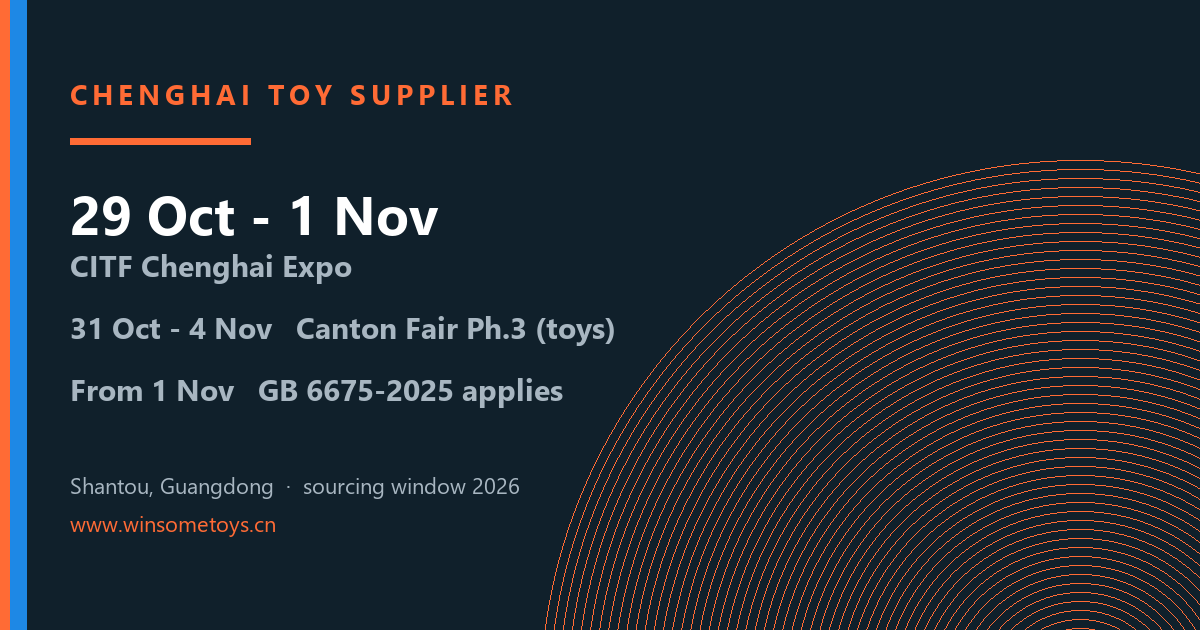
If you buy toys from China, the last week of October 2026 is the busiest week of the year in Guangdong — and one of the easiest to waste. The 25th Shantou Chenghai International Toy & Gift Expo runs from 29 October to 1 November, and the third phase of the 140th Canton Fair — the phase that carries toys and maternity and baby products — runs from 31 October to 4 November in Guangzhou. In the same window, China’s rewritten toy safety standard starts to apply. For any buyer weighing one Chenghai toy supplier against another, those three facts change what you should ask, and when.
This note is written for importers, distributors and retailers planning that trip. It separates what is confirmed from what is only announced, and ends with the checks that turn four days in Shantou into orders you can defend.
Two fairs, one trip — and two shared days
The Chenghai expo is held inside the production cluster rather than in a convention city. The Chenghai Toy Association puts the district at more than half of China’s plastic toy output and roughly a third of the world’s. The practical value is that a booth conversation can become a factory visit the same afternoon.
Confirmed details for the 25th edition: 29 October to 1 November 2026 at the Shantou International Convention and Exhibition Center, around 100,000 square metres across 11 halls and 12 themed zones, with more than 2,500 brands expected. The format keeps the first two and a half days for trade buyers and opens the remainder to the public, so the real sourcing window is 29–31 October. The Ministry of Commerce filing for the event was completed on 2 September 2026. For scale, the 24th edition in 2025 reported visitors from 52 countries and regions and RMB 15.8 billion of intent agreements.
The 140th Canton Fair runs in three phases from 15 October to 4 November, and this year is the fair’s 70th edition. Phase 3 (31 October – 4 November) is the toy phase: toys, maternity and baby products, stationery, bags and garments. There is no earlier toy window.
The two calendars share 31 October and 1 November. If you want both, work forward from Shantou: arrive on 28 October, use 29–30 for trade days and factory visits, then move to Guangzhou for 31 October.
1 November: China’s new toy standard starts to apply
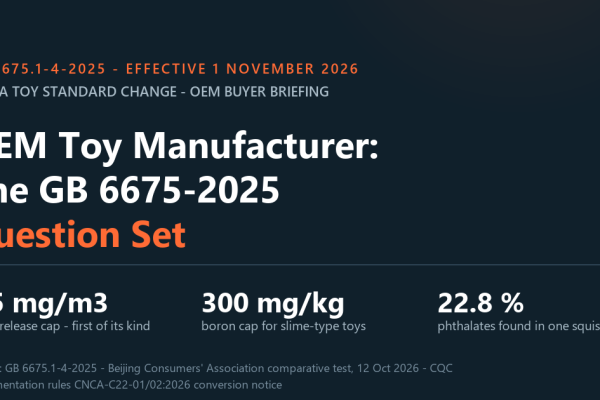
GB 6675.1 to GB 6675.4-2025 were published on 5 October 2025 and take effect on 1 November 2026, replacing the 2014 series that has been in place for more than a decade. It is the third major revision since the series was first issued in 1986.
For a buyer, the shape of the change matters more than the clause numbers. Chemical safety control categories expand from two to ten, adding requirements for formaldehyde, harmful aromatic amines, polycyclic aromatic hydrocarbons (PAHs), formamide, short-chain chlorinated paraffins, migratable N-nitrosamines and allergenic fragrances, and setting a total volatile organic compound (TVOC) limit for toys for the first time.
The certification side moves with it. CNCA Announcement No. 8 of 2026 (29 May 2026) revised the compulsory product certification rules for toys (CNCA-C22-02:2026) and children’s vehicles (CNCA-C22-01:2026), effective 1 November 2026. CQC’s notice of 2 September 2026 sets out the mechanics: from 1 November 2026 new certificates are issued against the new standard and no further old-standard certificates are granted; holders of existing certificates must convert, with conversion to be completed by 1 November 2027 or the certificate is suspended, and by 1 February 2028 or it is revoked.
None of this replaces EN 71, ASTM F963 or the CPSIA for the markets you sell into. What it changes is the evidence your supplier can produce. A factory that has just re-tested its materials across ten chemical categories holds fresher data than one that has not, and a factory that can tell you which version of the standard its report cites is easier to work with than one that says “it passes”.
The tariff lists: toys are in, connected toys are not
On 25 September 2026 the White House published a fact sheet following the state visit, and on 27 September the new U.S.–China Board of Trade published its working procedures and the two product lists for the “30-for-30” framework — roughly US$30 billion of goods in each direction. The U.S. list covers 77 HTSUS subheadings of Chinese consumer goods including small appliances, toys, highchairs and sporting goods. China’s list runs to 1,619 lines, mainly agricultural products, coal, cosmetics, wood and medical devices.
Two things in that package matter more than the headline. First, the toy entry is an “Ex-Out”: it excludes items enabled with radio-frequency, Wi-Fi, Ethernet or Bluetooth. Remote-control cars, Wi-Fi cameras and Bluetooth-enabled plush are not covered by the toy line. Second, the published documents set no rates and no effective dates. Trade advisers reading the framework have been explicit that nothing in it changes the duties that apply today; reductions go through each country’s own legal process, and the framework anticipates adjustments no more than once a year.
Chinese industry commentary has been more enthusiastic. The Chenghai Toy Association’s standing vice-president told Chinese media that toy exports to the US had been carrying additional tariffs of roughly 7.5% to 25%, and that the arrangement would restore most-favoured-nation rates for more than 90% of listed products. Customs data put China’s toy exports at US$15.597 billion in the first half of 2026, down 11.32% year on year — which explains the reaction. Treat it as expected, not booked.
What to do now: map your SKUs against the 77 lines including the Ex-Out wording; keep paying current rates; and monitor the Federal Register, HTSUS Chapter 99 amendments and CBP’s Cargo Systems Messaging Service for the implementing action, its effective date and which duty layers it reaches. Keep entry records accessible in case later guidance allows retroactive relief.
Two other landed-cost items took effect this month: CBP’s FY2027 fee adjustment (1 October) lifts the merchandise processing fee minimum to US$34.58 and maximum to US$670.86, and phase 3 of its CAPE refund programme for IEEPA duties opened on 6 October.
A checklist for the trip
Ten things that are cheaper to ask in Shantou than to discover at your warehouse.
- Send specifications two weeks ahead. Target market, age grading, standards and test scope. A quotation comes back faster and more accurately with the standard version named than with “EU/US compliant”.
- Ask which standard version the test report cites — and the report date. A report against the 2014 series is not the same document as one against GB 6675-2025.
- Separate made-in-house from bought-in. Moulding, painting, electronics and assembly are often in different buildings. Ask which lines the factory owns.
- Visit the incoming material area, not just the showroom. That is where filler, coating and resin risk actually lives.
- Ask about the last change, not the last order. Material substitution, colour change and cost engineering are when compliance quietly expires.
- Request the internal AQL and one recent inspection record. A record, not a certificate.
- Get a cost breakdown by resin, electronics and packaging, so tariff and currency moves can be re-priced line by line instead of renegotiated.
- Sign off packaging artwork before the packaging run, including importer details, lot marking and required warnings.
- Agree the alert procedure in writing: who notifies whom, in how many hours, and who pays.
- Take samples home and tie them to the quotation in your own files.
Where to go from here
If you are planning the late-October window, most of the work can be done before you land. Our OEM and ODM toy manufacturing page covers how development and production are run, and the toy quality control and safety compliance page covers what we check and document. Our base in the cluster is described on the Chenghai, Shantou toy factory page, and how we work with importers and distributors on the about page. Two categories are directly affected by this month’s changes: remote control toys, because of the radio-frequency exclusion above, and baby toys, because of the expanded chemical categories and the highchair lines in the tariff list.
Send us the SKUs you plan to review in Chenghai and we will tell you which of the checks above apply to each one, and what we can prepare before you arrive. Start an enquiry here.