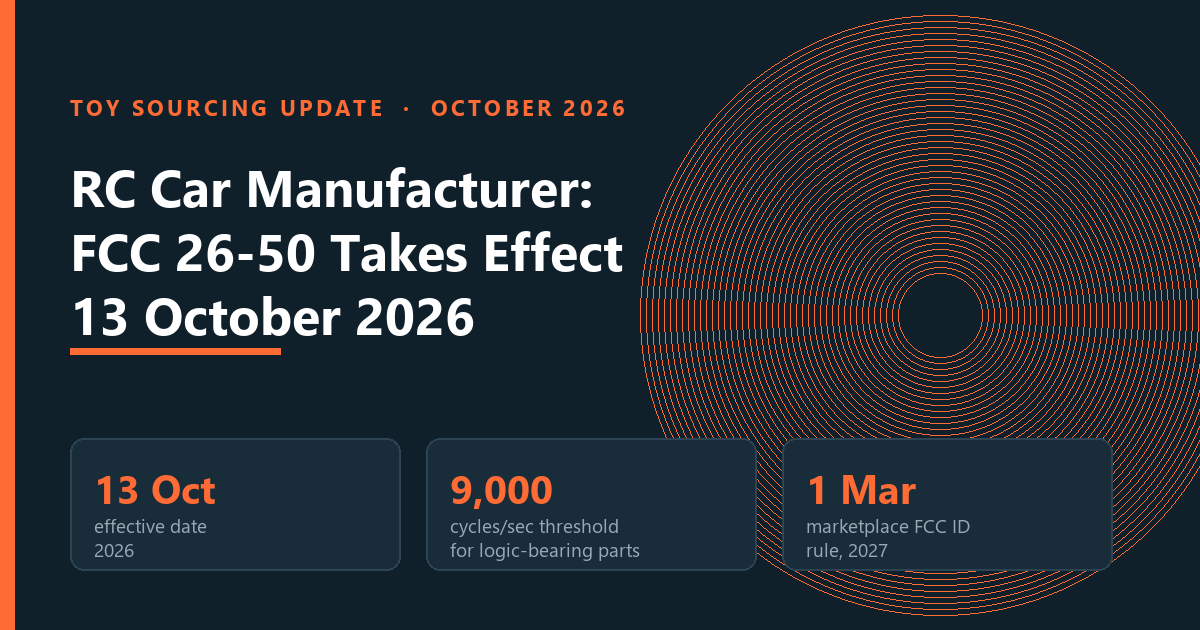
On 13 October 2026 the Federal Communications Commission’s Third Report and Order takes effect. It is catalogued as FCC 26-50 under ET Docket No. 21-232, adopted on 22 July 2026 and published in the Federal Register on 11 September 2026 at 91 FR 57798. Most of the coverage has been about drones and network equipment. Almost none of it has been about toys.
That gap is worth closing for anyone buying radio-controlled vehicles. The order amends 47 CFR Parts 1 and 2 — the equipment authorization programme that every product emitting radio energy passes through before it can be legally imported, marketed or sold in the United States. A 2.4 GHz RC car and its handset are radio devices. So if you work with an RC car manufacturer in China, the rule starting today is part of your supplier qualification, whether or not anyone calls it a toy rule.
What changed on 13 October
The Commission closed what it described as the component-part loophole. New 47 CFR 2.903(b) prohibits authorization of any device that incorporates a logic-bearing hardware component produced by an entity on the FCC’s Covered List, where the finished device would itself have been barred had that entity built the whole thing.
The definition, added at 47 CFR 2.902, is broad: any device, system, module, sub-assembly, integrated circuit or other physical component that generates and uses timing signals or pulses at more than 9,000 cycles per second using digital techniques, or that uses radio frequency energy to perform data processing such as computation, storage, sorting, retrieval or transfer.
Two limits matter in practice. The definition explicitly excludes purely mechanical or passive components — housings, fasteners, resistors, wiring and plain battery cells — and the Commission declined for now to extend the prohibition to software or firmware. The order also confirms that the marketing rules reach any entity that markets unauthorized equipment, including online marketplaces, and that a modification or permissive change made by a Covered List entity must go through full certification rather than the lighter permissive-change route.
Why an RC car is squarely in scope
An RC car is really two radio products in one box: the handset transmitter, which is an intentional radiator needing an equipment authorization with an FCC ID, and the receiver and control board inside the vehicle. Every microcontroller, logic IC and 2.4 GHz module in either one runs far above 9,000 cycles per second, so the passive-parts carve-out does not rescue the product.
The import side is separate and easy to overlook. Radio devices must meet an import condition under 47 CFR 2.1204, and the importer, ultimate consignee or broker must be able to show how, on request, for one year after entry under 47 CFR 2.1203. In practice that means the customs file for an RC shipment has to point at a specific authorization, not at a supplier’s assurance.
Three dates that matter more than today’s
- 13 October 2026 — the rule applies prospectively to new equipment authorization applications. Equipment already authorized is unaffected and may continue to be imported, marketed and used. Applications pending as of the effective date are exempt unless later amended to add, substitute or change a logic-bearing hardware component.
- 1 March 2027 — a marketplace that sells the device itself, or handles a third-party device it has physical access to or takes title to, must display a valid and accurate FCC ID at the online point of sale under 47 CFR 2.803(c)(1).
- 1 June 2027 — a marketplace hosting a third-party seller without physical access or title must display a valid FCC ID under 2.803(c)(2). It has a safe harbour if it took reasonable steps to verify the ID against the Commission’s Equipment Authorization System database and required the seller to certify the accuracy of what it supplied.
The cost-down trap
This is where buyers actually lose money. Grandfathering under the order is conditional, not permanent. Swap the main control IC, change the radio module, or move the board to a cheaper source to save a few cents a unit, and a pending application can lose its protected status — and the listing built on top of it loses its exemption too.
That listing point is drafted with unusual precision. A listing published before 13 October 2026 stays outside the FCC ID display duty unless and until it is amended, updated or republished on or after the effective date. An amendment includes a change to product description, product images, product specifications or seller information. It does not include non-substantive or automated changes such as search ranking, page layout, translation, pricing or currency display. A routine catalogue clean-up in 2027 therefore becomes a compliance event, not just a merchandising one.
What to ask before you sign the PO
- The exact FCC ID for the transmitter and for the vehicle, with the grantee code — then look it up in the Commission’s Equipment Authorization System yourself. Do not accept a photograph of a label.
- A written statement on logic-bearing components and who produced them. Enforcement rests on the applicant’s own attestation, so you want that attestation in your own file, naming the parts.
- A bill-of-materials freeze clause. The supplier should have to notify you before changing any IC, RF module or board revision, because that change can reset the authorization.
- Which route each part took — Certification with an FCC ID, or a Supplier’s Declaration of Conformity where the rules allow it. Ask about the transmitter specifically; it is the intentional radiator.
- A separate UK file. Great Britain is not the EU. On 23 September 2026 the UK published Notice of Proposal to Publish 0143/26, updating the designated standards that give presumption of conformity with the Toys (Safety) Regulations 2011: EN 71-4:2020 is replaced by EN 71-4:2020+A1:2025, and EN 71-15:2025 (formamide in foam materials) and EN 71-16:2025 (TCEP, TCPP, TDCP) are added, with a proposed in-force date of 22 October 2026. A separate UK call for evidence on aligning GB toy rules with the EU’s new Toy Safety Regulation closed on 6 October 2026, covering chemical safety, digital product passports, online marketplace obligations and AI-enabled or connected toys.
- Battery documentation. RC cars ship with lithium packs. Cells and batteries must pass the UN 38.3 tests before transport, and the maker and each later distributor must make a test summary available.
What this rule does not do
- It does not invalidate anything already authorized. Existing equipment may continue to be marketed, imported and used.
- It is not a toy safety rule. Nothing in it changes EN 71, ASTM F963 or CPSIA. Your toy safety file is separate and still has to stand on its own — see how we structure that work on our quality control and safety compliance page.
- Two listing exemptions exist: listings by third-party sellers that are not high-volume third-party sellers under 15 USC 45f(f)(6), and listings for used devices.
- Limited waivers previously granted by the FCC’s Office of Engineering and Technology for Class I and Class II permissive changes on Covered List UAS equipment and covered routers remain in effect through 1 January 2029.
Next step
None of this is a reason to stop buying RC cars from China. It is a reason to buy them differently: from a manufacturer that can name its radio components, that will freeze a bill of materials, and that treats the FCC ID as a document you are entitled to verify rather than a mark printed on a box. That is a conversation to have with your RC car manufacturer before the next container ships, not after it lands.
If you are reviewing an RC programme for the 2027 season, start with the radio file rather than the sample. See how we run OEM and ODM programmes, browse the current remote control toys range, and read about our factory in Chenghai, Shantou and about Winsome Toys. Send us the FCC ID you hold and the one you need, and contact our team for a straight answer on what still has to be tested.