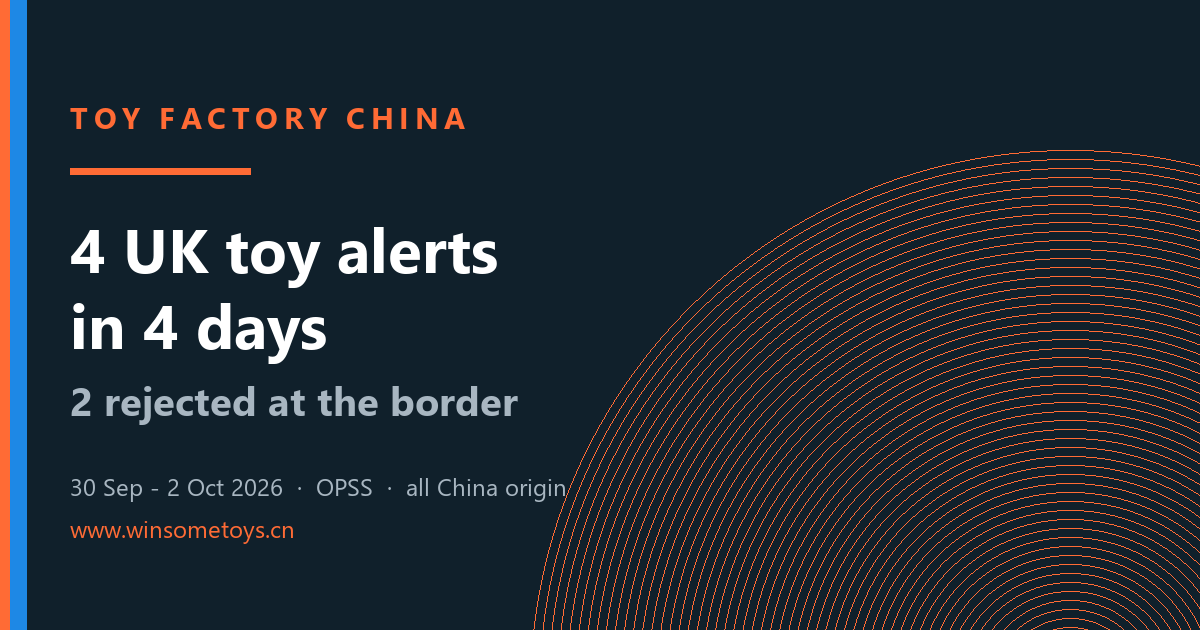
If you buy from a toy factory in China and sell into the UK, the first week of October 2026 is worth ten minutes of your time. Between 30 September and 2 October, the UK Office for Product Safety and Standards (OPSS) published four separate toy notices on GOV.UK. All four products were made in China. Two of them were stopped before they ever reached a shelf.
That combination should change how you brief your next production run. A recall is a cost you can model: refunds, replacement stock, some listing downtime. A consignment rejected at import is different — you have paid for goods you cannot sell, your retail window closes while the paperwork is argued over, and the evidence trail you would need to recover the money from your supplier was never built. The cheapest protection is no longer a tighter contract. It is a harder set of questions asked at the factory before production starts.
What OPSS published in four days
All four notices cite the same legal base — The Toys (Safety) Regulations 2011 — and all four list China as the country of origin. In date order:
- 30 September — YongnKids Theme Scene Sandbox Toy Kit (PSD case 2609-0148). A sand crafting and art box containing bags of coloured sand, sold via Amazon (ASIN BODPQ5M3P3, barcode X0026TZ9ZR). Hazard: the sand may be contaminated with a small quantity of asbestos. Measures taken: import rejected at the border, recall from end users, and removal of the listing by the online marketplace.
- 30 September — SHEIN Children’s Wooden Acrylic Rainbow Sensory Blocks (PSD case 2609-0191). Wooden blocks containing coloured sand (SKC sk26062823339701832428). Same hazard: possible asbestos contamination in the sand. SHEIN recalled the product from end users and contacted affected customers directly.
- 1 October — hahaland Baby Tissue Box Toy (PSD 2609-0079). A fabric soft toy styled as a baby tissue box, model PL002H, sold via Amazon (ASINs B0BZVPPQM7 and B0CJLWD1VM). Hazard: a serious risk of strangulation, because the toy contains two cords that exceed the permitted length for toys intended for young children. The cords could tangle and wrap around a child’s neck during play. Measures: import rejected at the border and the listing removed by Amazon.
- 2 October — My First Baby Spinner, sold by The Works (PSD 2609-0229). A spinning toy with a suction-cup base, brand Playworks, barcode 5052089365995, covering all batches including 186334, 184455, 181089, 181088, 181087, 181086, 180872, 180873 and 174513. Hazard: choking — small parts can detach or break off during reasonably foreseeable use, which is a particular risk for children under 36 months. The retailer recalled the product from end users.
UK press reporting on 1 October described the two sand notices as the latest in a series of asbestos-related toy recalls this year. Read that as a category signal, not one bad supplier: filled sensory toys and sand art kits share a raw-material risk that sits upstream of the factory that assembles them.
Why a border rejection costs more than a recall
Both outcomes are expensive, but they are expensive in different places, and only one of them is survivable for a smaller importer:
- A recall lands on your brand. You absorb refunds, disposal, delisting and the customer-service load, but the goods cleared and can be traced batch by batch.
- A border rejection lands on your cash. Stock sits between a port and a bonded warehouse while you argue about who pays. Your seasonal window does not pause for that argument.
- Liability follows the importer. In all four notices, the measures ran through the retailer, brand or marketplace — the operators the authority could reach.
- Recourse depends on evidence you ordered earlier. Without batch-linked test reports and a signed specification, a claim against a supplier is a negotiation, not a right.
Whether you can recover your money is decided weeks before the container is stuffed, not after the alert is published.
Three failure modes behind the four notices
Three buckets, three controls. No single test report covers all three.
1. Raw material you never specified
Asbestos in coloured sand is not a defect the assembler can see. It enters through a filling material bought from a sub-supplier, sometimes several tiers down. If your specification only says “coloured sand, non-toxic”, you have specified nothing you can enforce. Filled and sensory products — sand art, kinetic sand, water beads, slime — need the filler named, sourced and tested as a distinct input.
2. Geometry designed in, not made wrong
Cord length and detachable small parts are decisions made at the design and tooling stage. The hahaland notice is a cord-length failure; The Works spinner is a small-parts-under-load failure. Neither is a “bad batch”. Both are caught by mechanical and physical testing against the EN 71-1 series — but only when the test runs on the version you are actually shipping, after any cost engineering, colour change or material substitution.
3. Evidence that does not match the shipment
A test report is only useful if tied to the specific production. Reports that name a factory rather than a product, that predate a material change, or that were issued for another buyer’s SKU will not help when an authority asks. It is the most common gap between what importers believe they hold and what they can produce in 24 hours.
A pre-production checklist for your factory in China
Put this in writing before you release a deposit. Every item is the kind of thing that only gets asked after something goes wrong.
- Name every input, not just the product. Fillers, coatings, magnets and batteries each get their own line in the specification.
- Ask who supplies the high-risk inputs. For filled sensory toys, that means the sand source. If the factory will not name it, treat that as the answer.
- Tie the test report to a production batch. Report number, date, sample description and your product code in one document.
- Require re-testing after any change. Material, colour, tooling or sub-supplier changes should invalidate the previous report in your own process.
- Set the age grading first, then test to it. Cord limits, small-part rules and warnings all follow the declared age group. Changing it after testing quietly invalidates the file.
- Ask what happens to the approved sample. The sample that passed should be retained and referenced, not shipped to a trade show.
- Sign off labelling artwork before the packaging run. Importer details, lot marking and required warnings — not a sticker added at the end.
- Specify the transit state. Some products pass at dispatch and fail after a compressed carton sits in a hot container for five weeks.
- Agree the recall procedure in advance. Who notifies whom, in how many hours, and who pays. This is the clause you will actually read one day.
- Ask about alerts on the same product family. A serious factory tracks what its category is being pulled for.
Questions worth putting in writing
- Which harmonised standards do you test this product family against, and who issues the report?
- Who supplies the filling material, and can you show a test for it?
- If a UK authority contacts us about this SKU, what can you send us within 24 hours?
- Has this product family ever faced a border rejection or marketplace delisting?
A factory used to UK exports will have most of these answers ready. The point of asking is not to catch anyone out — it is to find out, while it is still cheap, whether you are buying a product or buying a risk.
Where to go from here
If you are reviewing UK-bound or EU-bound orders this quarter, the four notices are a reasonable template for what to re-check: filler materials on sensory and sand products, cord and small-part geometry on baby and soft toys, and batch-linked documentation across the board.
Our OEM and ODM toy manufacturing page covers how we run production, and the toy quality control and safety compliance page covers what we check and document. You can see where we sit in the supply base on our Chenghai, Shantou toy factory page, how we work with importers and distributors on the about page, and the affected categories in our baby toys and educational toys ranges.
Send us the product codes you plan to ship this quarter and we will tell you which of the checks above apply to each one. Start an enquiry here.