On 1 October 2026 the U.S. Consumer Product Safety Commission published a batch of twelve recall notices. Three of them were toys, and every one of them was a product most shoppers could not attach to a brand: 37,000 squishy dumpling and squib ball toys imported by ABC Trading, 480 Mochi Malrang mystery dumplings imported by LLK Trading, and 10,750 magnetic stick figure sets sold on Amazon under the name GBYMIUY. All three were made in China. All three were sold for between about 40 cents and $20, and all three are private label toys in the plainest sense: a factory’s product, someone else’s name.
A private-label programme lets a distributor, retailer or online seller put its own name on a factory’s product at a fraction of the cost of developing one. It also means that when the product fails a mandatory standard, the name on the recall notice is yours, not the factory’s. Below: what actually went wrong in the October notices, what changed in Europe, and the paperwork to lock down before the next order.
What CPSC announced on 1 October 2026
- ABC Trading — Squishy Dumpling Toys and Crazy Squib Ball Toys, recall 27-003. About 37,000 units, models 3655 and 3984. The water beads inside expand larger than the mandatory toy standard permits, which CPSC describes as a deadly ingestion hazard: a swallowed bead can cause choking and intestinal obstruction. Sold at ABC Trading stores in Los Angeles and nationwide from April to June 2026 for 41 cents to $1.25. Made in China. Remedy is a full refund, and buyers must write “RECALLED” on the toy, photograph it in the bin and email the photo.
- LLK Trading — Mochi Malrang Mystery Dumpling Toys, recall 27-006. About 480 units, translucent red, glitter and water beads, sold in a tan bamboo-steamer-style container. Same hazard language, same country of origin. Sold at Easy Wholesale in San Jose, California in July 2026 for about $10.
- GBYMIUY — Magnetic Stick Figure Toy Sets, recall 27-008. About 10,750 sets of 30 figures each, sold on Amazon.com from April to July 2026 for about $20. The figures can liberate loose, high-powered magnets. Swallowed magnets can attract each other through intestinal tissue and cause perforations, twisting, blockage, blood poisoning and death. Packaging is marked “GBYMIUY” and “X004TVHD2Z”.
None of the three reported injuries. That is not luck, it is the point: these recalls came from testing and market surveillance, not emergency rooms. Two earlier September notices covered about 8,000 squeezy dumpling units sold on Amazon and about 7,200 “Rainbow Mystery Squishy Bun” units on the same water-bead hazard, and a busy board recalled on 17 September failed because its zipper pull exceeded the federal lead limit. The pattern is stable enough to plan around.
Why this is a private-label problem, not a factory problem
Read the three notices again and notice what they have in common. In each case the recalling firm is a US-based importer or seller, not a Chinese manufacturer. In each case the product carries no brand equity and no engineering file behind it. In each case the price point — 40 cents, $10, $20 — means the margin cannot absorb a recall, a marketplace delisting or a civil penalty.
When you commission private label toys, you take on the role the regulation assigns to the producer. In the EU, the name and address of the manufacturer or importer must appear on the toy or its packaging, the CE marking must be affixed, and a technical file has to exist that someone can produce on request. In the US, CPSC looks to the importer of record. The factory that moulded the part is not the party on the notice.
Europe changed the test list on 14 September 2026
Two weeks before the CPSC batch, the European Commission adopted Implementing Decision (EU) 2026/2032 of 11 September 2026, amending Implementing Decision (EU) 2023/740. It added three references to the list of harmonised standards supporting Toy Safety Directive 2009/48/EC, effective 14 September 2026. Listing matters because it confers a presumption of conformity with the essential safety requirements covered.
- EN 71-4:2020+A1:2025 — experimental sets for chemistry and related activities. The previous EN 71-4:2020 keeps its status until 14 March 2028 and is then withdrawn, giving roughly 18 months to re-test affected lines.
- EN 71-15:2025 — formamide content in foam toy materials. Relevant to play mats, foam building blocks and any EVA or PU foam component.
- EN 71-16:2025 — certain chlorinated phosphorus flame retardants (TCEP, TCPP, TDCP) in toy materials.
For a private-label buyer the practical instruction is narrow: if any SKU in your range contains foam, or if you sell chemistry or science sets, your current test reports may no longer cover the current harmonised list. Ask for a re-test against the 2025 editions rather than assuming the old report carries over.
China’s own standard moves on 1 November 2026
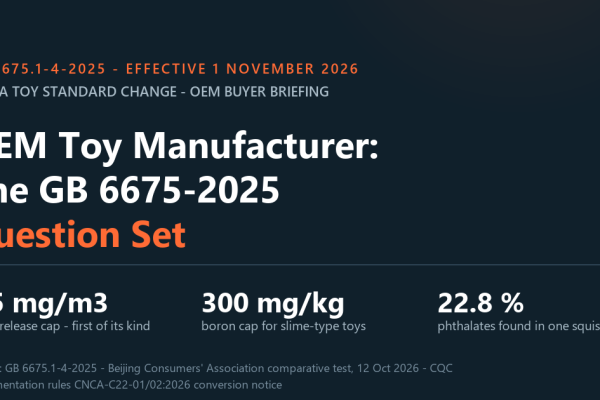
On the supply side, the revised GB 6675.1 to GB 6675.4 series takes effect on 1 November 2026, replacing the 2014 editions. It tightens limits on formaldehyde, TVOC and phthalates, and adds a boron limit for slime-type materials. If you also sell into the Chinese domestic market, or your supplier runs one line for both, that date belongs on your calendar.
A private-label spec checklist that would have caught all three
- Declare every functional material, not just the main plastic. Water beads, magnets, foam, coatings, zipper pulls and textile fillings each trigger a different clause. Two of the three October recalls failed on a component, not on the body of the toy.
- Fix the age grade before you fix the price. Small-part and magnet rules turn on the declared age. A 37,000-unit recall is what a wrong age grade costs.
- Specify the test by clause, per SKU and per colourway. “EN 71” or “ASTM F963” on a quotation is not a scope. Name the parts and the clauses, and require separate reports for colourways that use different pigments or plating.
- Require abuse testing, not only as-received testing. Magnet liberation and detachable small parts show up after drop, torque and tension tests, which is exactly how CPSC describes the failure.
- Lock a golden sample and a retention sample. Signed, dated, photographed, and referenced in the purchase contract. Without it there is no baseline to argue from.
- Put packaging artwork into the approval loop. Country of origin, importer name and address, age warning and tracking code are compliance content, not graphic design.
How to read a test report before you release payment
- Check that the sample description matches the production SKU, including colour and age grade.
- Check the standard version and date against the list currently in force — the EU list changed on 14 September 2026.
- Check whether the sample was submitted by the client or pulled by the lab from production.
- Check that the lab is accredited for that specific standard, not generally accredited.
- Check that material changes since the report date triggered a new report.
What this means if you are planning a 2027 programme
None of the above argues against private label. It is still the fastest route from an idea to a shelf-ready SKU, and for most distributors the only route that makes the maths work. What the October notices show is that the cheap version of private label — buy from a listing, ship it, print your logo — has become expensive. The cost of a re-test against EN 71-15 or a per-colourway magnet test is a rounding error next to a 37,000-unit recall.
If you are building a private-label range and want a second opinion on a specification or a test report, our OEM and ODM programme covers product development, sampling and packaging, and how we handle quality control and safety compliance sets out the checks we run before a container leaves. You can browse the current range by category — educational toys, DIY and craft toys and plush toys are common starting points for private-label buyers. To discuss a specification, send us the details.