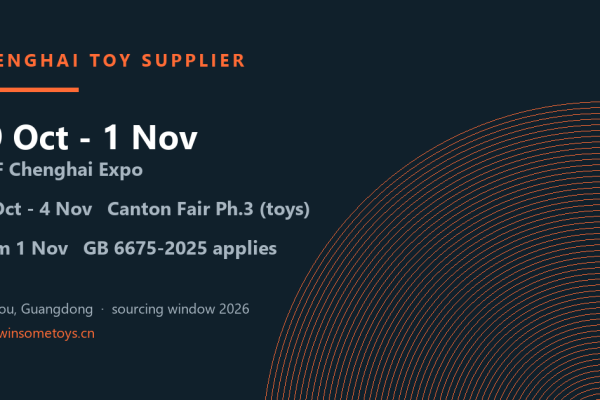
The 140th Canton Fair opens in Guangzhou on 15 October 2026 and runs to 4 November, split into three phases. If you buy toys, only one of those phases matters. Toys sit in Phase 3, from 31 October to 4 November, alongside baby and maternity products, children’s wear, stationery, sporting and travel goods, personal care and food.
Phase 1 (15–19 October) is machinery, appliances, vehicles and service robots. Phase 2 (23–27 October) is housewares, gifts, holiday products and furniture. The halls close on 20–22 October and again on 28–30 October for changeover. That detail has cost buyers a full week in Pazhou: book a mid-October flight expecting toy halls and you will spend it looking at kitchenware.
What Phase 3 covers — and why the phase split helps buyers
Phase 3 is the consumer-goods phase. Toys are one of 21 exhibition sections scheduled across it, out of 54 sections in the export exhibition as a whole. The phase therefore bundles categories that would otherwise need separate trips: toys, baby and maternity, children’s wear, apparel, footwear, bags, home textiles, stationery, food and pet products.
The scale matters. The 139th session drew about 314,000 overseas buyers from 220 countries and regions, and the 140th is the fair’s 70th-anniversary edition, with roughly 1.55 million square metres of floor space.
- Toys are not the only category you can cover in one trip; the same visit covers plastic toys, baby goods and stationery.
- Phase 3 opens on a Saturday and closes on a Wednesday. The opening weekend is the densest period on the floor; the calmest hours for a technical conversation are the closing days.
- The organiser’s catalogue and app run year-round. Shortlist exhibitors and note booth numbers before you fly; the floor plan is too large to browse.
The export backdrop that changes what you should be looking for
China’s toy exports have had a difficult 2026. Customs data cited in a listed Chinese toymaker’s half-year report put first-half toy exports at roughly USD 15.6 billion, down 11.3% year on year. Yet output from the established southern clusters is still growing: Huangpu Customs reported that Dongguan’s toy exports reached RMB 10.77 billion in the first half of 2026, up 8% year on year, shipped to more than 120 countries.
Together the two figures say the same thing. Volume is draining out of the bottom of the market — undifferentiated, price-only supply that cannot show a factory, a current test file or a custom brief — and concentrating in the suppliers who can. At a fair of this size, the buyer’s job is elimination, not discovery.
What to shortlist before you fly
- Categories by function, not by item. Educational and STEM, plush, RC, outdoor, pretend play, baby. A function list survives a trend cycle; an item list does not.
- A price band per slot, stated as a landed-cost ceiling rather than an FOB target. Duty, freight and testing sit on top of FOB and usually change the answer.
- Destination rules per SKU. Which market, which age grade, whether it is battery-operated, whether it contains small parts or water beads. Those four answers decide which test file you need.
- Packaging format and retail channel. Window box for a shelf, polybag for e-commerce, display carton for an impulse counter.
- Order quantity split across the range, so the supplier can tell you where tooling is and is not involved.
- Sample and lead-time expectations in writing, so the booth conversation ends on a number instead of a promise.
Five questions that separate a real factory from a trading counter
Trading companies are legitimate and common. The problem is discovering one after paying a tooling deposit. These five questions settle it in ten minutes.
- Where are the machines? Ask for the factory address and set it beside the address on the test report and the business licence. If they differ, ask who owns the moulds.
- Can I see the last test report for this exact product? Same tooling, same material, every colour, dated within a year, issued by a CPSC-accepted laboratory for the US market.
- What are the tooling terms? Cavity count, steel, expected shot life and who owns the mould once it is cut. This is the point of no return in a custom program — the OEM and ODM process belongs on the table before the deposit.
- Which parts are certified, and which are bought in? Motors, batteries and LED modules carry their own documentation. Ask who holds it.
- Can you price the same item in two packaging formats? The delta tells you whether the quote was calculated or assembled.
Documents and test files to collect at the booth
For the United States, a toy for children twelve and under needs third-party testing at a CPSC-accepted laboratory and a Children’s Product Certificate citing ASTM F963-23 plus the applicable CPSIA rules — lead limits, eight phthalates at 0.1%, small-parts compliance for under-threes and a permanent tracking label on product and packaging. Battery-operated items add the electrical sections.
For the EU, ask for EN 71 test reports and CE marking under the Toy Safety Directive, with EN 62115 for electric toys. Certification is where a sourcing decision becomes a legal one; how we run that pass on our lines is set out in our quality control and safety compliance process.
The failure modes regulators acted on this quarter
Three recalls from September 2026 are worth reading as a buyer’s checklist rather than as news.
- Small balls, under-threes. On 3 September 2026 the CPSC announced the recall of about 963 spiral toys sold on SHEIN.com between September 2025 and May 2026 for USD 6–16. The toy contains small balls and is intended for children under three, which violates the small ball ban. Health Canada issued the same recall on 4 September for 660 units sold in Canada.
- Water beads. Also on 3 September, the CPSC recalled water-bead dumpling toys sold on Amazon — about 8,000 units under one brand and about 7,200 under another. The beads expand when swallowed. The defect was the age grading and the labelling, not the material.
- Button cells. On 10 September 2026 ZMC Group expanded a recall of light-up children’s toys to about 245,124 units, including 124,560 recalled in May 2026, because the button-cell batteries could be reached by a child.
None of these is an exotic hazard. Each traces back to a decision made at purchase-order stage: an age grade set too low, a battery compartment designed too easily, a small ball included in a toy for under-threes. That is why the paperwork matters more than the prototype on the table.
After the fair: the first 30 days
- Sample within seven days. A supplier who ships a sample in a week can usually hold a production date.
- Golden sample signed by both sides, with colour chips attached, before any tooling deposit is paid.
- Test report pulled from the production lot, not an old report for a similar item.
- Pre-shipment inspection booked with defect definitions and the AQL written into the purchase order, not agreed verbally.
- Landed cost modelled at the current duty stack before you commit to a volume.
The factory leg: Chenghai
A show produces a shortlist, not a decision. The pattern that works is to use Guangzhou to compare products side by side, then make the second leg of the trip to the cluster that makes your category. Chenghai, in Shantou, Guangdong, is one of China’s principal plastic toy clusters and sits roughly four hours by high-speed rail from Guangzhou — a workable two- or three-day visit after Phase 3 closes on 4 November.
That visit is where the five questions get answers you can verify: the machines, the tooling, the test file, the cartons. You can see our own toy factory in Chenghai for what that looks like on the ground.
Buyers who cannot fly out should insist on a live video walkthrough of the actual line, not a showroom tour.
The short version
Phase 3 of the 140th Canton Fair runs 31 October to 4 November 2026, with toys among its 21 sections. For toy orders due in Q1 2027, this is the last large-format buying window of the year. The export data says the supply base is consolidating, which rewards buyers who arrive with a shortlist, a document request and a follow-up calendar rather than a blank notebook.
Tell us which categories you are sourcing and we will help you prepare the shortlist before you fly — send the brief here.