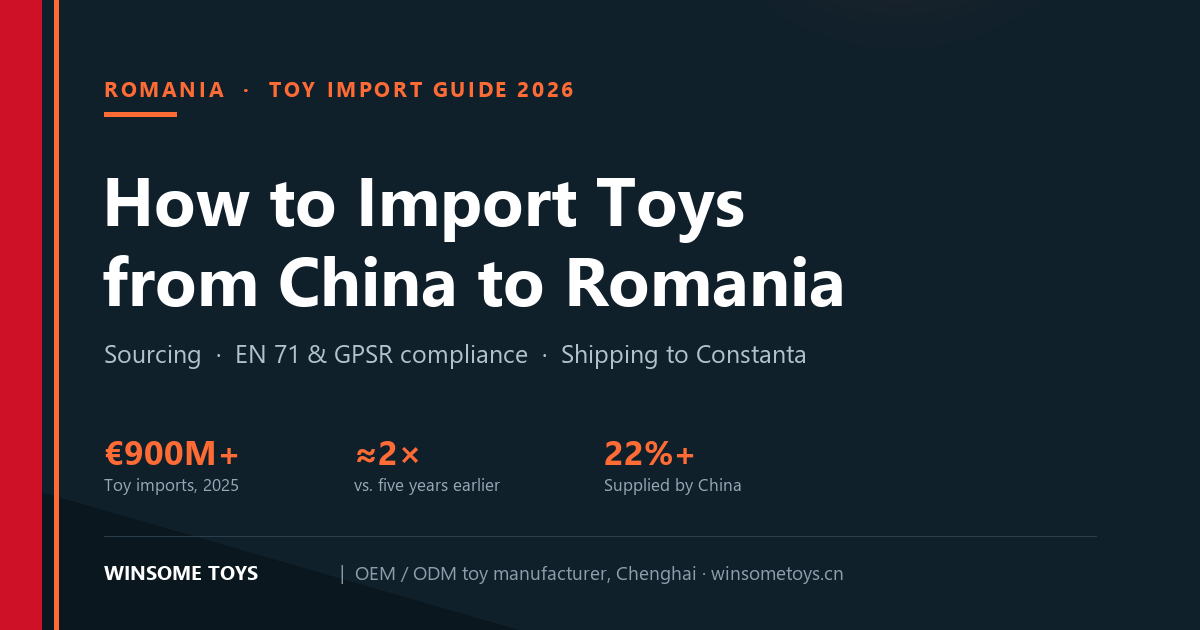
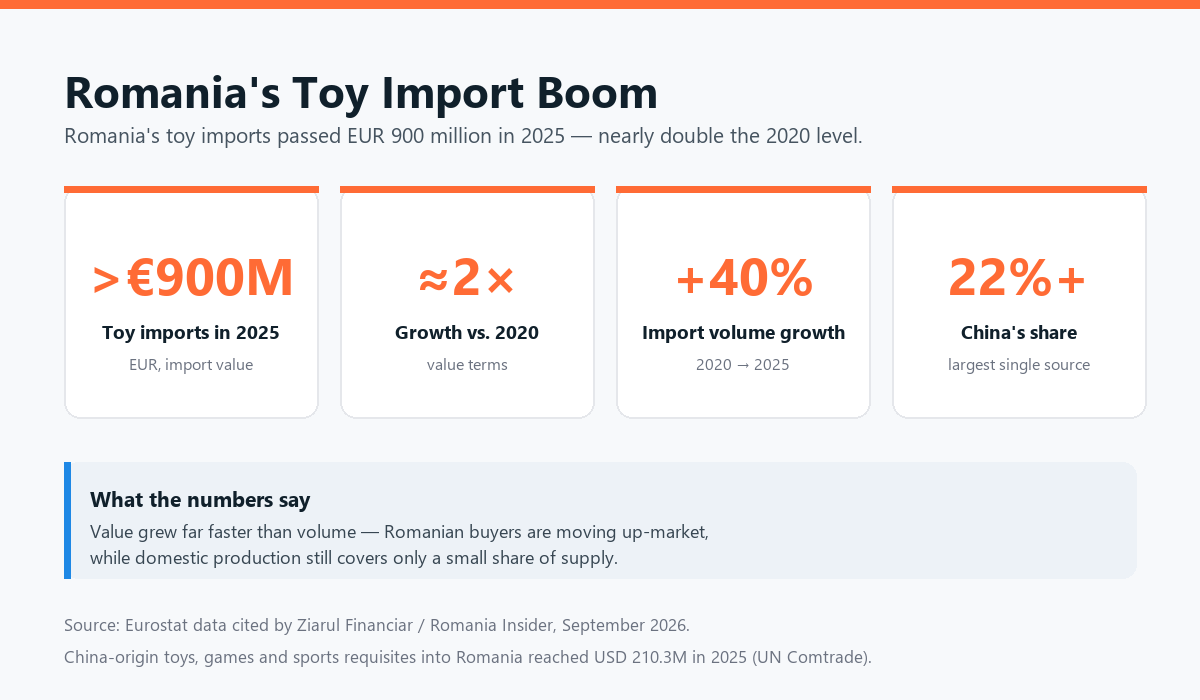
Romania has quietly become one of the fastest-growing toy import markets in the European Union. Toy imports passed EUR 900 million in 2025 — close to double the level of five years earlier — and China is still the single largest source of supply. For wholesalers, distributors and private-label retailers planning to import toys from China to Romania, that mix of fast-growing demand, heavy import dependence and a short supply line from Chinese factories is a genuine opening.
What the headline number does not tell you is that the route from Chenghai to Bucharest is not the same as the route to Hamburg or Rotterdam. Romania applies the full EU rulebook, but it layers on its own customs and road-transport formalities — the ones that most often catch first-time importers — and its main gateway is a Black Sea port rather than a North Sea one. This guide covers the market numbers, the compliance file, the shipping options and the supplier questions that decide whether your first container lands profitably.
Romania’s Toy Import Boom — €900M Market by the Numbers
| Indicator | Latest reading | What it means for a buyer |
|---|---|---|
| Toy import value, 2025 | Over EUR 900 million | Large enough to support a dedicated range, not a single trial SKU |
| Growth vs. 2020 | Nearly 2× in value | Demand kept expanding well after the post-2021 freight shock |
| Import volume, 2020–2025 | About +40% | Value grew roughly twice as fast as volume |
| China’s share of import value | More than 22% | Largest single source, ahead of every EU supplier |
| Domestic production | A small share of supply | Romania depends on imports; there is no local capacity to fall back on |
The most useful signal here is the gap between the two growth rates. Import volume rose about 40% between 2020 and 2025, while import value almost doubled. Romanian buyers are not simply moving more units — they are moving more expensive units. That points to a market trading up: boxed and licensed product, larger play sets, better packaging, higher perceived quality. If your Romania plan is a container of low-price filler items, you are competing in the slowest-growing part of the market.
There is a second structural point worth understanding. Research on the same dataset notes that Greece appears as the second-largest source of Romanian toy imports, but that a meaningful share of those goods are Chinese-made products moving through Greek distribution networks — which is what you would expect from a retailer such as Jumbo, a Greek chain with an extensive sourcing operation in China. Chinese product is therefore already on Romanian shelves. Your competition is not “Chinese imports versus European manufacturing”; it is you versus the importer layer already sitting between the factory and the shelf. That is an argument for going direct — and for knowing your landed cost to the cent.
Seasonality matters as much as the annual total. Toy demand in Romania, as across the EU, concentrates into the second half, so the buying window closes earlier than most first-time importers assume. We covered the timing and the duty maths in our wholesale toy buying plan for Q4, which is worth reading alongside this guide.
Why Chinese (Chenghai) Toys Dominate Romania’s Supply
China supplies more than 22% of Romania’s toy import value — a larger share than any other single country. In absolute terms, Romanian imports of toys, games and sports requisites from China reached about USD 210 million in 2025 according to UN Comtrade data. Behind those numbers sits a manufacturing cluster that most Romanian buyers never visit but that shapes their entire cost structure: Chenghai, a district of Shantou in Guangdong province, and one of the largest toy production bases in the world.
Chenghai’s advantage is not one giant factory — it is density. Mould making, injection moulding, painting, printing, electronics assembly, plush processing and packaging all sit within a short drive of each other. For an importer, that density shows up in three practical ways:
- Faster sampling loops. A change to a mould, a colour or a blister card can be turned around in days rather than weeks, because the supplier is not shipping parts across a province.
- Lower tooling cost. Competition between hundreds of mould shops keeps new-tool pricing tight, which lowers the volume threshold at which a private-label design becomes viable.
- Category breadth. The same cluster covers baby and infant toys, plush, educational and STEM lines, outdoor and novelty products — so a mixed container can be built without juggling five unrelated suppliers.
The catch is that density also means wide variation in capability. Two factories ten minutes apart can differ enormously in test-report quality, packaging discipline and documentation. Vetting is therefore not optional — it is the single biggest determinant of whether a Chenghai-sourced container clears Constanta smoothly or sits in a warehouse racking up storage fees.
Step-by-Step Import Process: Sourcing → Sampling → Shipping
Step 1 — Write the brief before you ask for quotes
Most first orders go wrong before a single email is sent, because the buyer asks for “your best price on toys” instead of a defined brief. Before you contact anyone, fix five things: the target retail price and therefore the target FOB band; the age grade; the sales channel (hypermarket, toy specialist, e-commerce, discounter); the packaging format; and the compliance scope, including which EN 71 parts apply. A supplier who receives a proper brief can quote a real number. A supplier who receives a vague one will quote low and adjust later.
Step 2 — Shortlist factories and verify them independently
Ask each candidate for their business licence, their export history for your target market, and product test reports issued by an accredited laboratory for comparable items. Then verify rather than trust — the vetting checklist is further down this page.
Step 3 — Sample, and lock a golden sample
Order samples against your brief, not against the supplier’s existing catalogue. Once you approve a sample, sign and date a physical golden sample and keep one copy yourself and one at the factory. That single object prevents most quality arguments at mass production, because it is the reference both sides agreed on.
Step 4 — Test and build the technical file
Commission testing against the exact standard versions that apply at the time of shipment, not the ones that applied when the artwork was drawn. See the compliance section below for what changed in September 2026.
Step 5 — Production and pre-shipment inspection
Book a pre-shipment inspection before the goods are packed into the container, not after. Once cartons are loaded, a defect becomes a claim against a shipping line rather than a conversation with the factory.
Step 6 — Book freight and clear customs
Choose your Incoterm deliberately. FOB gives you control and a lower headline cost but leaves you responsible for everything from the port onwards. DDP hides that complexity, usually at a markup — and you still own the compliance obligation either way.
Step 7 — Pay duty and VAT, then move inland
EU customs duty is assessed on the CIF value, and Romanian VAT is charged on CIF plus duty. Budget for both before you commit to a selling price.
| Stage | Typical industry duration | What most often goes wrong |
|---|---|---|
| Brief and quoting | 1–2 weeks | A vague brief produces uncomparable quotes |
| Sampling and revision | 2–4 weeks | Only one sample round was budgeted for |
| Testing and documentation | 2–4 weeks | Tested against an outdated standard version |
| Mass production | 4–6 weeks after sample approval | Chinese New Year and the Q3 capacity crunch |
| Sea freight to Constanta | Roughly 35–48 days door-to-door | Booking left too late for the pre-Q4 peak |
| Customs and inland delivery | 2–7 days | UIT code not generated before departure |
Treat those durations as planning references, not commitments — they vary by product, factory loading and season, and should always be confirmed in writing with your supplier before you commit to a retail on-sale date.
EU Compliance Checklist: EN 71 (incl. new -15/-16), CE, GPSR, EORI
Romania applies EU toy law in full, so compliance is not a Romanian-specific exercise — but the paperwork obligation sits with you as the importer. The operative law remains Directive 2009/48/EC, while the replacement Toy Safety Regulation (EU) 2025/2509 entered into force on 1 January 2026 and applies from 1 August 2030 after a 54-month transition. You must comply with today’s rules now, and structure your compliance data so it survives the 2030 switch — we covered that in our complete EU toy safety regulation guide and in our breakdown of the Digital Product Passport for toys.
The three new harmonised standards (September 2026)
On 14 September 2026, Commission Implementing Decision (EU) 2026/2032 added three revised EN 71 standards to the harmonised list supporting the Toy Safety Directive. From that date they carry a presumption of conformity:
| Standard | Covers | Effective |
|---|---|---|
| EN 71-15:2025 | Formamide content in foamed toy materials — relevant to play mats, soft blocks and similar foam products | 14 Sep 2026 |
| EN 71-16:2025 | Certain chlorinated phosphorus flame retardants (TCEP, TCPP, TDCP) in toy materials | 14 Sep 2026 |
| EN 71-4:2020+A1:2025 | Experimental sets for chemistry and related activities | 14 Sep 2026 |
Two practical consequences. First, if your range includes foam or play-mat items, your test scope has changed — older reports do not cover formamide content. Second, the superseded EN 71-4:2020 remains usable for conformity assessment only until 14 March 2028; after that it no longer supports a presumption of conformity, so any chemistry-set SKU should be retested well before then.
The rest of the compliance file
| Requirement | Who owns it | Practical note |
|---|---|---|
| CE marking on product or packaging | Manufacturer — but the importer must verify it | Missing CE marking is a common cause of cargo being held or ordered for re-export |
| Technical file and EU Declaration of Conformity | Manufacturer; the importer must be able to produce it | Keep it where you can supply it within 24 hours of a market-surveillance request |
| EN 71 test reports matching your SKU | Factory, commissioned by you | Reports must name the exact product and the exact standard version |
| GPSR obligations — Regulation (EU) 2023/988 | Importer | Name and address of a responsible person in the EU, plus traceability and online-listing details |
| EORI number | Importer | Issued in Romania through ANAF; without it you cannot file a customs declaration |
| UIT code (RO e-Transport) | The party with commercial control of the goods — normally you | Required for road transport above 500 kg gross or RON 10,000 per consignment |
| ISPM 15 treated wood packaging | Factory | Untreated pallets or crates can trigger a phytosanitary hold |
The Romania-specific trap most importers miss: the UIT code
Romania’s RO e-Transport system requires a UIT code — a unique transport identification code generated through ANAF — for road transport of consignments exceeding 500 kg gross or RON 10,000 in value. International movements into Romania, including imports, are covered regardless of the type of goods. The code must be obtained before the vehicle departs, is valid for 15 calendar days on international transport, and must travel with the driver.
Enforcement of the associated obligations, including GPS data transmission, has applied with penalties since 1 January 2026. Fines reach RON 50,000 for a missing or incorrect code and up to RON 100,000 for false information, with seizure of goods a risk in serious cases. A container that clears customs correctly can still be stopped inland without it. Agree in writing with your broker or forwarder who is generating the code — and make sure the declaration is filed in your name.
Duty and VAT on toys entering Romania
Toys under HS heading 9503 attract EU customs duty of up to 4.7%, and Romania’s standard VAT rate is 21%, applied to the CIF value plus duty. A worked illustration:
| Line | Illustrative amount |
|---|---|
| Goods value, CIF Constanta | EUR 20,000 |
| Customs duty at 4.7% | EUR 940 |
| VAT base (CIF + duty) | EUR 20,940 |
| VAT at 21% | EUR 4,397 |
| Total duty and VAT | EUR 5,337 |
That is an arithmetic illustration, not a quotation. The duty rate depends on the exact commodity code of each item in your container, and the CIF value depends on your freight terms. Classification errors are expensive — misclassifying a product can trigger back-taxes and penalties — so have your broker classify the range before you ship. To see how compliance failures actually play out at the border, our review of the 2026 toy recalls and what they teach importers makes a useful reality check.
Shipping Routes & Lead Times to Constanta Port
Constanta is Romania’s main maritime gateway and the largest port on the Black Sea, with around 156 berths and annual throughput in the order of 100 million tonnes. Beyond being a destination port, it works as a distribution hub: cargo arriving at Constanta can move on by road, rail or the Danube waterway into Central and Eastern Europe. If your plan extends beyond Romania into neighbouring markets, Constanta is an asset rather than a cost to be minimised.
| Mode | Typical door-to-door transit | Best suited to |
|---|---|---|
| Sea FCL, 20ft | Roughly 35–48 days | Bulk, full-carton mixed orders |
| Sea FCL, 40ft / HQ | Roughly 35–48 days | Large-volume, low-density product such as plush |
| Sea LCL | Roughly 38–52 days | Small-to-medium trial orders |
| Rail FCL | Roughly 25–35 days | Mid-value cargo when sea is too slow |
| Air freight | Roughly 5–10 days | Samples, urgent replenishment, high unit value |
Those ranges are 2026 market references and vary with carrier, routing and season — always work from a binding quotation for your own cargo.
One cost warning that catches nearly every new importer: a port-to-port quote looks dramatically cheaper than a door-to-door one because it excludes everything after the vessel berths. Terminal handling, port storage, demurrage, customs examination, brokerage and inland trucking are charged separately, and a single customs delay can add several hundred to well over a thousand euros in unplanned cost. Compare quotes on a landed, delivered basis, always.
How to Choose a Reliable Chinese Toy Supplier
Supplier selection is where Romanian importers gain or lose the most money, and it is the part that cannot be fixed later by a good freight rate. Work through these six questions with every candidate factory:
- Can you show test reports from an accredited lab, for this exact product? Not a certificate of the factory’s quality system, and not a report for a similar item — a report that names the product you are buying and the standard version it was tested against.
- Do you have genuine OEM and ODM capability? OEM means the factory builds to your design and artwork. ODM means it can develop the product itself from your brief. Ask which of the two applies, and ask who owns the tooling. Our OEM/ODM manufacturing page sets out how we split the two.
- Who handles QC, and to what standard? Ask for the inspection stages and the acceptance criteria, and ask to see a sample inspection report. Our own process is documented on the quality control and safety compliance page.
- Can you support an audit? A factory that resists a third-party audit, or cannot arrange one at short notice, is telling you something.
- How is packaging handled? Carton dimensions, carton strength, loading quantity per carton and container load plan all feed directly into your freight cost per unit. A supplier who cannot give you carton specifications is costing you money quietly.
- What is your documentation turnaround? Ask how quickly they can supply the technical file, declaration of conformity and shipping documents. Slow documentation is the most common cause of a container sitting at Constanta.
Red flags worth acting on: a quote that ignores compliance testing entirely; prices far below the material cost of the product; no willingness to put the agreed specification in writing; and a refusal to name a reference customer or provide audit access. Any one of these is a reason to keep looking.
Frequently Asked Questions
How much does it cost to import toys from China to Romania?
Expect EU customs duty of up to 4.7% on the CIF value for toys under HS 9503, plus Romanian VAT at 21% on CIF plus duty, plus freight and destination charges. On an illustrative EUR 20,000 CIF shipment of toys, duty and VAT together come to about EUR 5,337. Freight, terminal handling, customs brokerage and inland trucking are additional and vary with volume, mode and season.
Do I need an EORI number to import toys into Romania?
Yes. An EORI number is required to file a customs declaration. In Romania it is issued through ANAF. If you use a DDP arrangement, your forwarder can clear goods under their own EORI while you obtain yours — but the compliance obligation as the party placing toys on the market stays with you.
Do Chinese toys need CE marking to be sold in Romania?
Yes. Toys placed on the EU market, Romania included, must carry CE marking and be supported by a technical file and an EU Declaration of Conformity. Romania applies EU law in full, and CE marking is checked at the border, not only by market surveillance afterwards.
What are EN 71-15 and EN 71-16?
They are two new harmonised standards added to the list supporting the Toy Safety Directive on 14 September 2026 by Commission Implementing Decision (EU) 2026/2032. EN 71-15:2025 covers formamide content in foamed toy materials; EN 71-16:2025 covers the chlorinated phosphorus flame retardants TCEP, TCPP and TDCP in toy materials. Both carry a presumption of conformity from that date.
How long does shipping from China to Constanta take?
As general 2026 market references: sea freight door-to-door runs roughly 35–48 days, sea LCL roughly 38–52 days, rail roughly 25–35 days, and air freight roughly 5–10 days. Actual transit depends on carrier, routing and season.
What is a UIT code and do I need one?
The UIT code is Romania’s unique transport identification code under the RO e-Transport system, generated through ANAF. It is required for road transport of consignments exceeding 500 kg gross or RON 10,000 in value, including imports into Romania, and must be obtained before departure. It is valid for 15 calendar days on international transport.
Request our catalogue and compliance file pack
We manufacture in Chenghai, Shantou — inside the cluster described above — and we supply importers and wholesalers with OEM and ODM toy programmes, including the test reports, declarations and carton specifications you need to clear Constanta without surprises. You can see the operation on our Chenghai toy factory page, or go straight to the OEM and ODM manufacturing services overview.
Send us your brief — target price band, age grade, category and destination — and we will come back with a quotation, a realistic timeline and the compliance documents for the relevant EN 71 parts, including the new EN 71-15 and EN 71-16 scope where it applies.
If you are ready to import toys from China to Romania, start with the paperwork conversation rather than the price conversation. Getting the standard versions, the carton specification and the UIT responsibility right at the quoting stage costs nothing; getting them wrong after the container has sailed costs a great deal.
Request the Winsome Toys catalogue and compliance file pack →